In 2025, Korea raised its engagement with the world by widening the scope of its diplomacy and making its economy show resilience amid turmoil. Korean culture permeated the daily lives of people worldwide, and Korean society progressed as a community where others from abroad coexisted with Koreans. This fourth and final installment of a series on Korea in 2025 focuses on the economy.
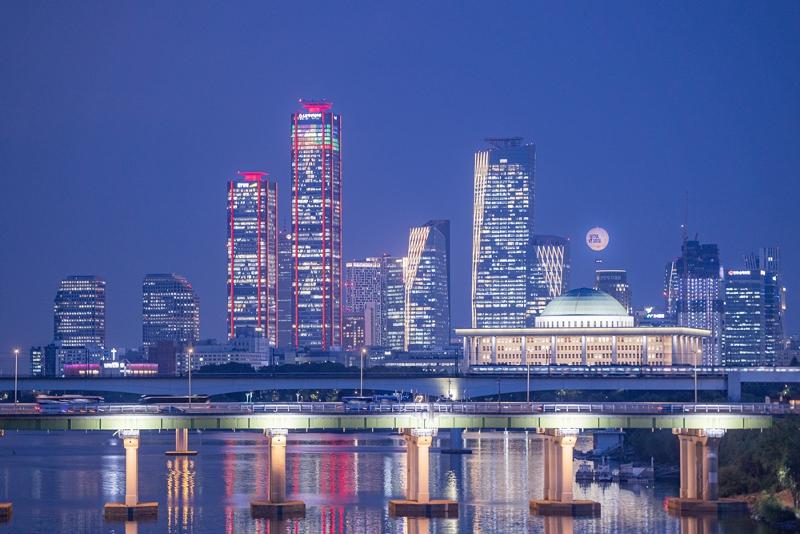
The helium balloon Moon of Seoul on Aug. 17 floats above the financial district of Yeouido in Seoul's Yeongdeungpo-gu District. (Seoul Metropolitan Government)
By Kim Seon Ah
The Korean economy in 2025 faced complex obstacles such as the prolonged strategic competition between the U.S. and China, restructuring of global supply chains, high interest rates, and climate and energy crises.
Though economic growth remained limited, the securing of mid- to long-term competitiveness and external confidence was prioritized over short-term gains.
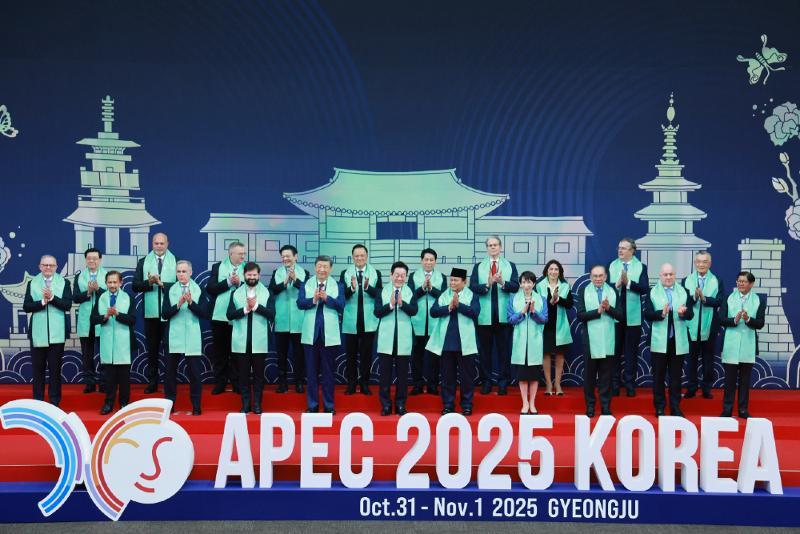
President Lee Jae Myung (sixth from left in front row) on Nov. 1 poses for a group photo with heads of state attending the Asia-Pacific Economic Cooperation Economic Leaders' Meeting at Gyeongju Hwabaek International Convention Center in Gyeongju, Gyeongsangbuk-do Province. (Yonhap News)
APEC hosting earns center stage in economic diplomacy
The hosting of the APEC (Asia-Pacific Economic Cooperation) Economic Leaders' Meeting in Gyeongju, Gyeongsangbuk-do Province, punctuated the nation's economic diplomacy. Rather than just traditional talks on free trade, the event was a stage for economic security, sustainable growth, industrial transition toward digital and artificial intelligence (AI), and technical cooperation.
Highlighting the digital economy and AI, stable supply chains, and the harmonization of carbon reduction and industrial competitiveness as key agenda, Korea championed its role as a middle power.
Seoul also proposed a cooperation model focused on "diversifying risk" rather than "decoupling" and connected policy measures and markets through the APEC CEO Summit. This led to practical results in attraction of investment and business cooperation.
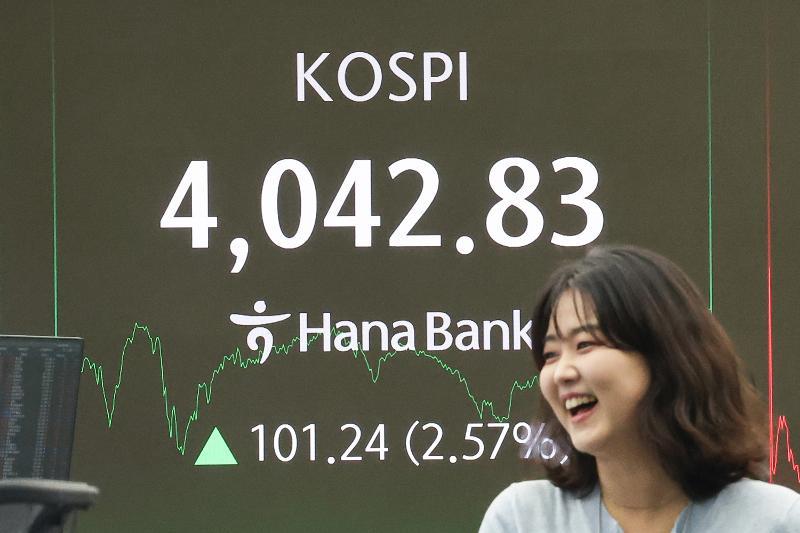
The main stock market KOSPI is displayed on Oct. 27 on an electronic bulletin board at the dealing room of Hana Bank headquarters in Seoul's Jung-gu District. (Yonhap News)
Entry into World Gov't Bond Index, stock market reevaluation
Trust in Korea built through economic diplomacy translated into progress in financial markets. The country's inclusion in the World Government Bond Index attested to international recognition of the institutional credibility of the domestic capital markets.
The nation's entry in a major bond index used by global pension funds and asset management companies showed Korea's rise as a leading investment destination for government bonds.
Thanks to this trend, the Korea Composite Stock Price Index, aka KOSPI, the country's main stock market, surpassed 4,000 for the first time. The reevaluation of the stock market was due to expectations for higher corporate performance, especially in semiconductors and AI, corporate value-up policy and talks on restructuring capital markets.
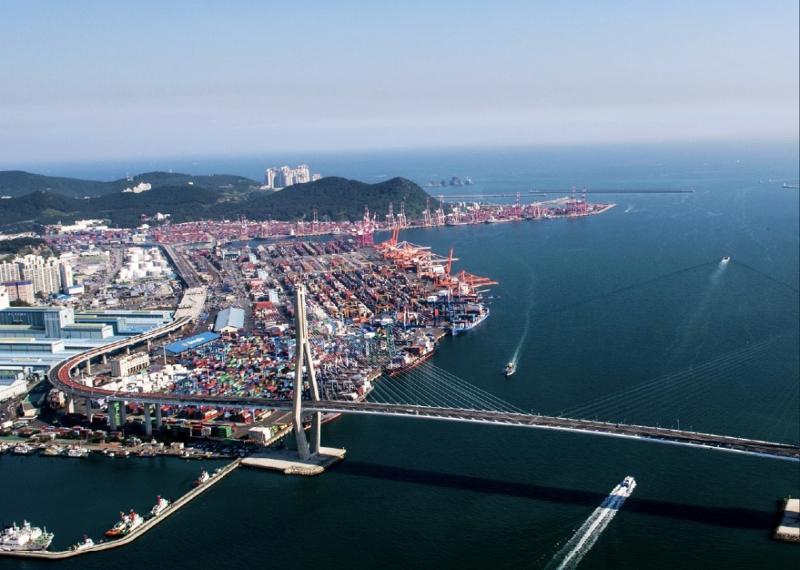
Semiconductor exports this year are projected to exceed USD 165 billion, their second straight year of setting a record high. Shown is North Port of Busan Port. (Busan Port Authority)
Positive signals from surging chip, consumer goods exports
Positive changes were seen in exports, a key economic indicator, led by semiconductors as well as beauty products and food to maintain overall growth.
Chip exports this year were forecast to set a record for the second straight year with USD 165 billion. Rising demand for high bandwidth memory due to expanded investment in AI servers and data centers is considered to have led this growth.
Consumer goods based on Hallyu (Korean Wave) also saw higher exports. World markets for beauty products rose to over 200 in number to set a record, and overseas shipments of food such as ramyeon (instant noodles) and gim (dried seaweed) grew for the ninth consecutive year, showing the diversification of the nation's export structure to encompass cutting-edge industries and consumer goods.
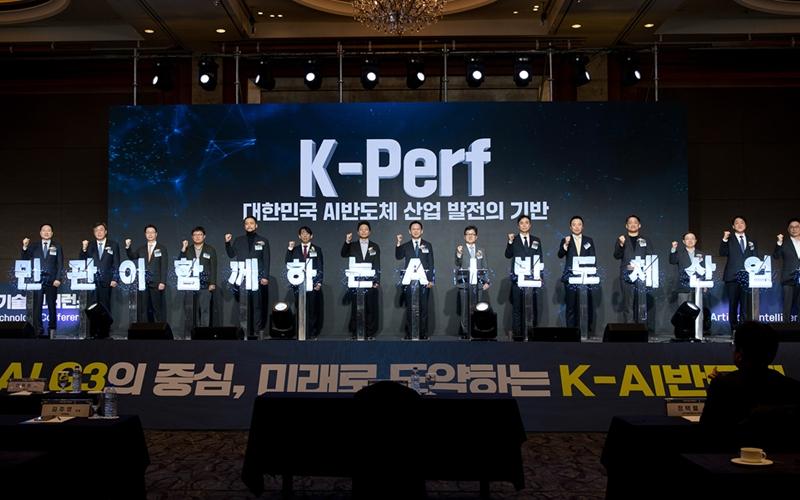
Deputy Prime Minister and Minister of Science and ICT Bae Kyunghoon (standing behind the letter "A") on Dec. 10 attends the launching ceremony for the K-Perf Consortium at the AI Semiconductor Future Technology Conference held at Lotte Hotel in Seoul's Jung-gu District. (Ministry of Science and ICT)
AI, e-gov't seen as future growth engines
Another defining trait of the economy was the launch of the basis for future growth based on AI and e-government. Based on its extensive experience in digital and data-driven administration, the country incorporated AI into the public sector to raise administrative efficiency and achieve industrial ripple effects.
National capacity in e-government has drawn global attention as a benchmark and new type of economic competitiveness combining technology and institutions.
Thus 2025 is expected to be remembered as a year in which the economy's direction and strength underwent reassessment amid growing global uncertainty, with key choices made to solidify the basis for future progress despite slow growth.
sofiakim218@korea.kr
![[2025 review ③] Immigration policy goes from 'mgmt.' to 'settlement'](/upload/content/image/6a413d99597146b0ab69fc03729b0e7c_20251215143455.jpg)
![[2025 review ②] Restoration as 'global pivotal state'](/upload/content/image/1064bcdcfc1c40ba8635fb1495199735_20251208161248.jpg)
![[2025 review ①] 'Demon Hunters,' 'Squid Game,' 'APT.' rule Hallyu](/upload/content/image/2af3d0e0e7e744458e956eb53575d3f5_20251208111037.jpg)