In 2025, Korea raised its engagement with the world. Its scope of diplomacy widened and its economy showed resilience amid turmoil. Korean culture permeated the daily lives of people worldwide, and Korean society progressed as a community where others from abroad coexisted with Koreans. This third installment of a series on Korea in 2025 focuses on immigration policy.
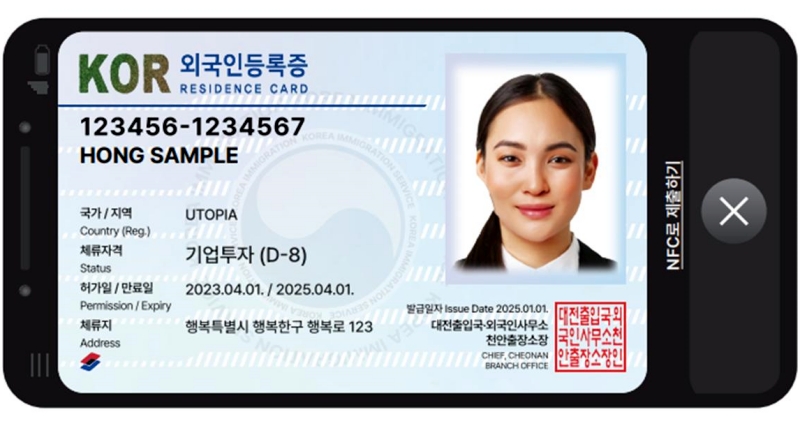
The Ministry of Justice on Jan. 10 launched the use of digital IDs for registered expats. (Ministry of Justice)
By Kang Gahui
The number of expats in Korea reached an annual record-high 2.83 million in October, or 5.5% of the national population of 51,684,564 as of July 1. As the country turns into a multicultural and immigrant society, the focus of government policy toward foreign residents rapidly shifted from "management" to "settlement and protection of rights."
In line with this trend, 2025 saw comprehensive institutional changes including expanded accessibility to administrative services by foreign residents, guaranteed rights of multicultural children and youth, and reinforced protection of foreign workers.
Mobile ID for expats
Digital infrastructure for public administration and living for expats was greatly expanded this year.
On Jan. 10, the country began issuing digital IDs for foreign residents. Any registered foreign resident aged 14 or older with a smartphone in his or her name could receive one for use at many places such as public and financial institutions, convenience stores and hospitals.
Heightened financial accessibility also came this year for expats. In May, verification of a foreign resident's ID for a transaction was expanded from the primary financial sector to seven institutions in the second.
This meant higher access by expats to services at financial institutions like banks, credit card and securities companies, and insurers as well as through mobile apps and the web. The change was thanks to the high-tech ability to authenticate foreign residence cards in real time.
The Ministry of Justice on Feb. 24 launched the Korea Electronic Arrival Card, aka the e-Arrival card, which allows the submission of an entry declaration form online. From December, the number of nationalities eligible for automated immigration clearance at Incheon International Airport was raised from four -- Germany, Taiwan, Hong Kong and Macao -- to 18.

The Ministry of Justice has extended the guaranteed stay of children of people living in the country illegally to March 31, 2028. (CJ Welfare Foundation)
Protection of migrant children and youth
Institutional improvements have raised protection of the right to education and the identities of migrant children and youth. A three-year extension of stay was granted on March 20 to the children of foreign nationals living illegally in the nation.
In addition, foreign youth who graduate from high school in Korea can seek jobs and settle in the nation without needing to attend university.
From April 1, such youth were made eligible for the D-10 (job seeker or training) and E-7-Y (employment) visas if they meet the following conditions: being in the age range of 18-24 as of the date of application, residence in the country for over seven years before turning 18, and graduating from elementary, middle or high school in Korea.
Starting on June 24, the restriction was lifted on the number of Hangeul (Korean alphabet) characters for the name of a child born to one Korean and one foreign parent, raising the range of choices.
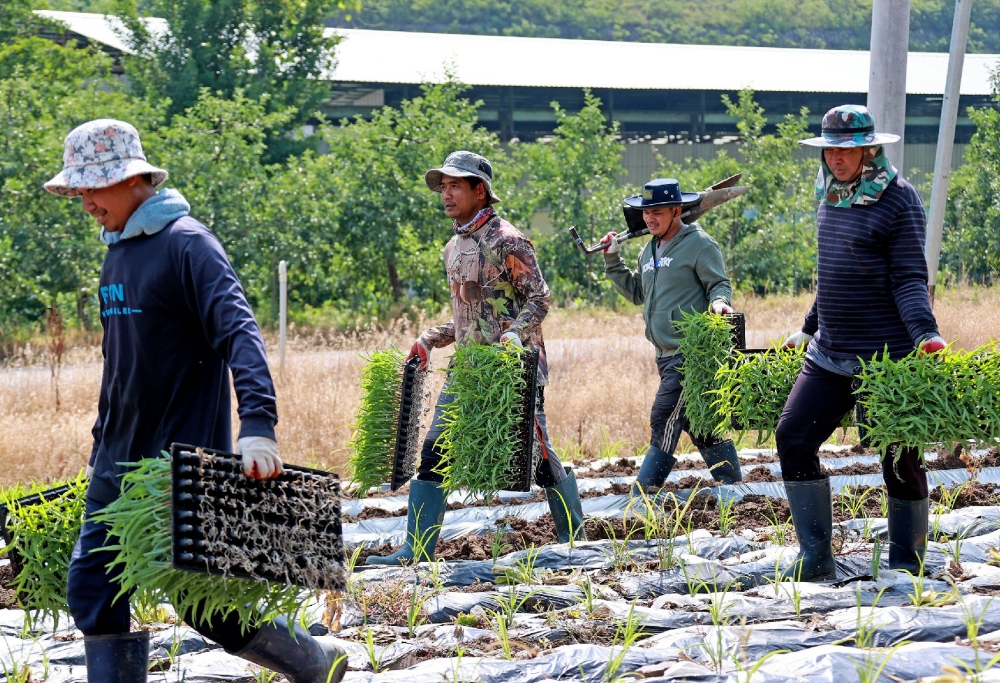
Seasonal workers from Cambodia on June 24 sow corn seeds at a farm in Goesan-gun County, Chungcheongbuk-do Province. (Goesan-gun County Office)
Higher protection of foreign workers' rights
The protection of foreign worker rights also received a boost. A Ministry of Employment and Labor meeting on Sept. 9 on the Employment Permit System decided to relax requirements to allow such staff to more easily change their workplaces if they face unfair treatment or dangerous work conditions.
A multilingual system of labor law consultation based on artificial intelligence also began providing legal advice on issues such as unpaid wages, unfair dismissals and industrial accidents. If a human rights violation was detected, the Immigration Contact Center (1345) provided tailored support depending on the offense and referred the victim(s) to its one-stop solution center or the ministry's consultation center for foreign workers.
Foreign laborers with unpaid wages no longer need to worry about deportation. Under an amendment to the Enforcement Decree of the Immigration Act, the Ministry of Justice on Nov. 6 exempted labor inspectors from reporting the visa status of such workers suffering from damage like back pay issues.
kgh89@korea.kr
![[2025 review ④] Reliable, competitive economy amid low growth](/upload/content/image/7d0cf764608f436694fc058c34a11a2b_20251216132950.jpg)
![[2025 review ②] Restoration as 'global pivotal state'](/upload/content/image/1064bcdcfc1c40ba8635fb1495199735_20251208161248.jpg)
![[2025 review ①] 'Demon Hunters,' 'Squid Game,' 'APT.' rule Hallyu](/upload/content/image/2af3d0e0e7e744458e956eb53575d3f5_20251208111037.jpg)