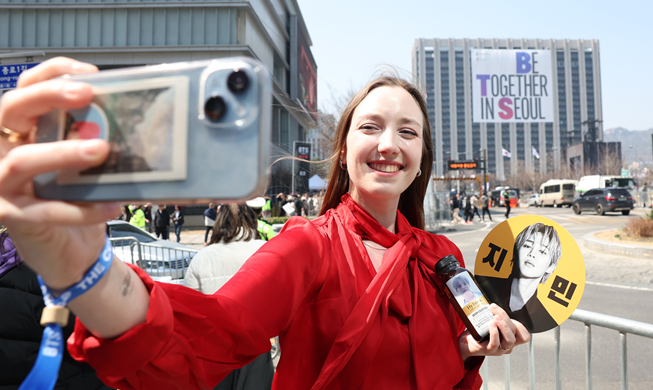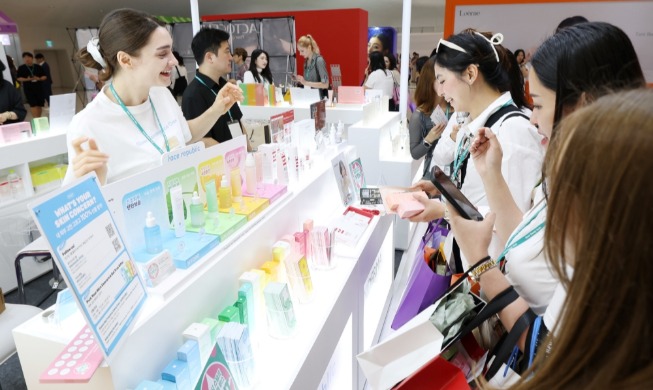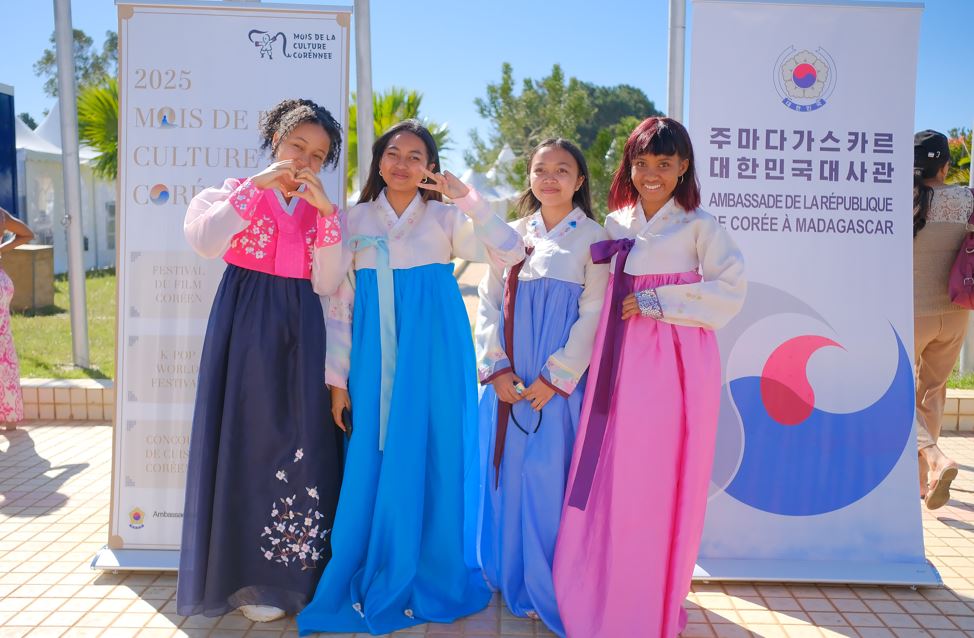
Visitors in May last year pose for photos at the 2025 K-Beauty Festival hosted by the Korean Embassy in Antananarivo as part of the Madagascar International Fair. (Korean Embassy in Madagascar)
By Charles Audouin
Hallyu (Korean Wave) is rapidly spreading throughout Africa.
Instead of just driving content consumption, the popularity of Hallyu is raising sales of consumer goods like cosmetics and food to create a new market ecosystem.
The report "Africa Focus" released by the Korea-Africa Foundation on April 30 said the number of Hallyu fan club members skyrocketed 196-fold from 2014-2023, far above the global average of 6.5.
Han Seoni, associate research fellow at the Korea Institute for International Economic Policy, said, "The African region previously had limited exposure to Korean cultural content, so their experiences with K-culture have apparently had a greater effect in raising their impressions of Korea and its image."
Hallyu's influence is reflected in trade data. As of 2024, Korea exported cultural consumer goods to 45 African countries and imported USD 33.4 billion from them. South Africa was the continent's biggest export market, followed by Nigeria, Morocco, Ghana, Libya, Algeria, Egypt and Senegal.
The top 10 African countries accounted for USD 19.5 billion in imports, or 58.3% of Africa's total and driving growth on the continent.
Cosmetics and beauty products formed the widest export network. Exports from the sector to Africa from 2021-24 showed annual average growth of 53%, the highest among cultural consumer goods.
Han said, "This shows that the improvement of our national image based on the spread of Korean cultural content leads to stronger demand for select consumer goods."
Korean food exports to Africa last year rose 19.1% year on year, the country's second highest after the Middle East (22.6%).
"The consumer goods market in Africa is considered to have high long-term growth potential driven by population growth, urbanization and the expansion of a young consumer base," she added. "We need strategies that translate the favorable impression and awareness based on K-culture into actual trade in consumer goods."
"To enter the African market for consumer goods, Korea should use beauty products as leading items to broaden its market base in the early stage and gradually expand market penetration to food, fashion and household goods."
caudouin@korea.kr