Busan in July hosts the 48th session of the UNESCO World Heritage Committee. To mark this occasion, Korea.net introduces six of the country's 12 tentative candidates for World Heritage status.
By Margareth Theresia
Photo = Lee Jeongwoo
Video = Park Dae Jin
The nation's Buddhist heritage has long captivated the world through intricate and majestic works like Seokguram Grotto, Bulguksa Temple and Janggyeong Panjeon (Depositories for the Tripitaka Koreana Woodblocks) at Haeinsa Temple. Yet a temple that seems to break Buddhist traditions is located in Hwasun-gun County, Jeollanam-do Province.
Unjusa Temple features unique stone buddhas and pagodas that UNESCO in 2017 added to its Tentative List of States Properties.
Unjusa is different from traditional Buddhist temples as it breaks away from formalized traditions to embrace simplicity and folk humor rooted in common life. The site contains the well-preserved quarry where the stones used to make the statues and pagodas were extracted, as well as traces of their transportation.
This rare and comprehensive view of the production process of Buddhist art from a thousand years ago presents high academic value. The scene of pagodas of diverse styles in a single space like Unjusa is also rarely found elsewhere worldwide.
The true essence of Unjusa lies in its inclusiveness and embrace of multiple religions in a single space. The diverse stone buddhas and pagodas made between the 10th and 16th centuries, along with stones resembling the constellation Big Dipper, a vestige of star worship, reflect a unique world view in which Daoism, worship of the heavens and folk beliefs, are interwoven with Buddhism.
The concentration of several belief systems at a single temple is extremely rare even in East Asia, thus Unjusa possesses high value as a heritage of humanity.
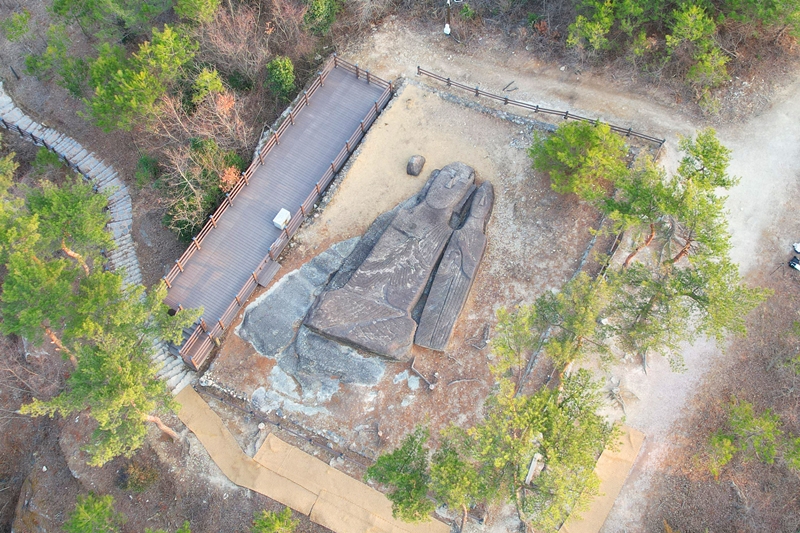
This giant reclining Buddha statue is on a hill overlooking the western valley of Unjusa Temple.
The temple's use of its terrain also stands out. Unjusa is situated along a mountain valley with a gentle slope and an elevation of around 100 m in the upper reaches of the Daechocheon Stream, a tributary of the Yeongsangang River.
The pagodas and stone buddhas lined along the ridgelines on both sides of the valley, which stretches from north to south, show the original layout that aimed to maximize use of the natural terrain.
The exact date of Unjusa's founding remains unclear, with scholars saying it probably flourished from the mid- to late Goryeo Dynasty (918-1392). After undergoing major reconstruction in the late 15th century, the temple is believed to have been destroyed during the Imjin Waeran, or the Japanese invasion of the Korean Peninsula in the late 16th century.
Starting with a modest reconstruction effort in the mid-19th century, the temple saw several rounds of repair and restoration in the 20th century to take on its present form.
Today, the site has about 141 stone pagodas and 115 Buddha statues that span both completed and unfinished or damaged artifacts.
Over 70 stone Buddha statues of varying sizes are dispersed throughout the mountains, ranging in size from a few dozen cm to large structures over 10 m tall. Their flat and simple forms and slightly disproportionate depictions of the human body clearly reflect the traits of provincial Buddhist sculpture from the Goryeo era.
The pagodas also feature unconventional forms, with their shapes and decorative expressions extremely diverse. The number of stories (steps) ranging from three, five, seven or more is also inconsistent.
Pagodas built on circular bases or sporting unique styles that resemble stacked discs stand out for their sculptural qualities, diverging from the typical conventions of Buddhist stone pagodas.
Unjusa's most iconic feature is the gargantuan reclining Buddha statue on a hill overlooking the western side of the valley. Measuring 12 m long and 10 m wide, the structure was sculpted in a fully reclining posture, an exceptionally rare case in Korea.
The legend of "a new world to emerge when this Buddha rises" shows the strong aspiration of the people at the site a thousand years ago.
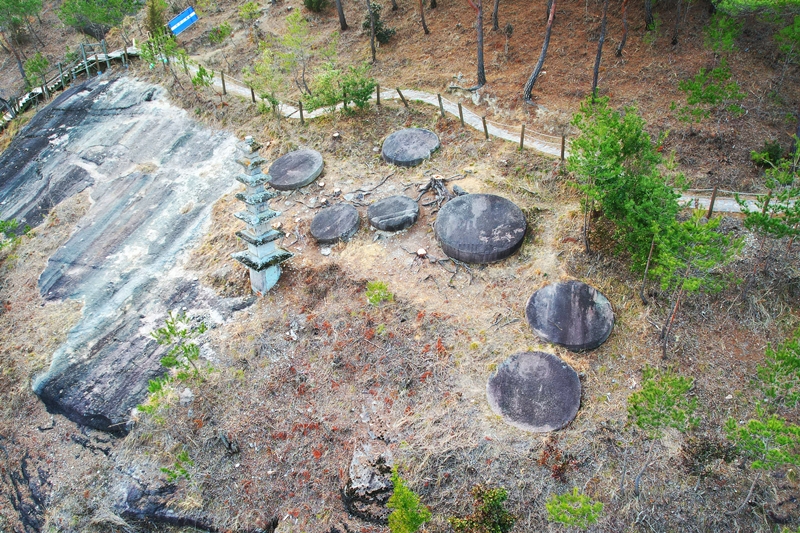
Rocks whose form resembles the constellation Big Dipper near the gigantic statue of the reclining Buddha reflect the integration of religious belief of star worship, which originated from Daoism, and Buddhism at Unjusa Temple.
margareth@korea.kr
![[World Heritage candidates] ② Capital Fortifications of Hanyang](/upload/content/image/b4b3560f9a744c8faf89ea5c0c902a1a_20260309082721.jpg)
![[World Heritage candidates] ① Busan: refugee hub of Korean War](/upload/content/image/2013b0a594b344268b6e4bca4795ad63_20260121105424.jpg)