
The director and cast of the acclaimed film "Parasite" on Feb. 9, 2020, pose for a photo after their wins at the Academy Awards ceremony held at Dolby Theatre in Los Angeles. (Academy of Motion Picture Arts and Sciences)
By Yoo Yeon Gyeong
"How did Korean cinema reach the center of the global film industry?"
This question is asked in "K-Film," the second episode of CNN's original series "K-Everything." The answer given is the power of Korean storytelling rather than flashy visual techniques or huge production budgets.
The biggest competitive edge in Korean cinema, it said, lies in its ability to interpret universal themes such as social contradictions and human nature through the lens of Korean society's distinctive reality and sentiment.
Domestic movies have elicited global empathy through stories that are deeply Korean, covering themes like class conflict and competition, changes in community, and memories of pain and healing emerging from the country's rapid industrialization, democratization and economic development. Through their acute portrayal of reality while not ignoring human emotions, such works have gone beyond culture and language to resonate with viewers around the world.
CNN said Korea's cinematic success was not due to individual directors or specific works, but the creative ecosystem and industrial foundation built over decades. The expansion of freedom of expression led to the creation of an environment allowing filmmakers to cover a wider range of subjects.
Outstanding production personnel and an investment structure that supports new experiments also stimulated the unique competitiveness of Hallyu (Korean Wave) cinema.

From left are CEO of Yong Film and producer Syd Lim (Lim Seung-yong), actor Choi Min-sik, and directors Park Chan-wook and Chung Chung-hoon on May 22, 2004, taking a group photo after "Oldboy" wins the top honor Grand Prix at the Cannes Film Festival at Palais des Festivals in Cannes, France. (Festival's media library)
"Cultural architects," or entrepreneurs who provide long-term investment and support, play a crucial role in the film industry. Strategies to develop both creators and the sector rather than pursue short-term success at the box office formed the basis for the advancement of Korean cinema.
In 2004, director Park Chan-wook's "Oldboy" achieved global prominence by winning the Grand Prix at the Cannes Film Festival, and director Bong Joon Ho's "Parasite" in 2020 catapulted Korea to the industry's global stratosphere by sweeping the Oscars for Best Picture, Best Director, Best Original Screenplay and Best International Feature Film.
The greatness of Korean cinema is also shown by its export performance after "Parasite." The Korean Film Council said overseas sales of completed domestic films last year reached USD 50.28 million, up 19.9% from USD 41.93 million in 2024.
Korean directors and actors have also taken on projects abroad, demonstrating that Korean film's influence.
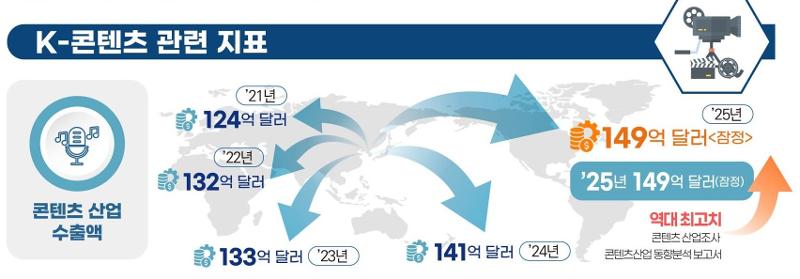
A 2025 government survey on Korean content released on Feb. 27 said the sector's exports set a record-high USD 14.07 billion in 2024, up 5.5% from the prior year. (Ministry of Culture, Sports and Tourism)
Such results fueled growth of the overall content industry. The Ministry of Culture, Sports and Tourism on Feb. 27 in a 2025 survey said content exports in 2024 set a record-high USD 14.07 billion, up 5.5% year on year, citing visual content including cinema as key drivers of Hallyu abroad and the growth of content exports.
To sustain this momentum, the ministry will strive to build a long-term creative ecosystem by fostering up-and-coming creators, advancing production infrastructure and expanding joint production opportunities worldwide. It will also back customized support systems so that Korean cinema can keep releasing original stories and new works on the global market.
dusrud21@korea.kr


![[Global K-life] ① K-pop enters mainstream via connecting people](/upload/content/image/60d3becbd18543d69eec641f3b853485_20260706084227.jpg)