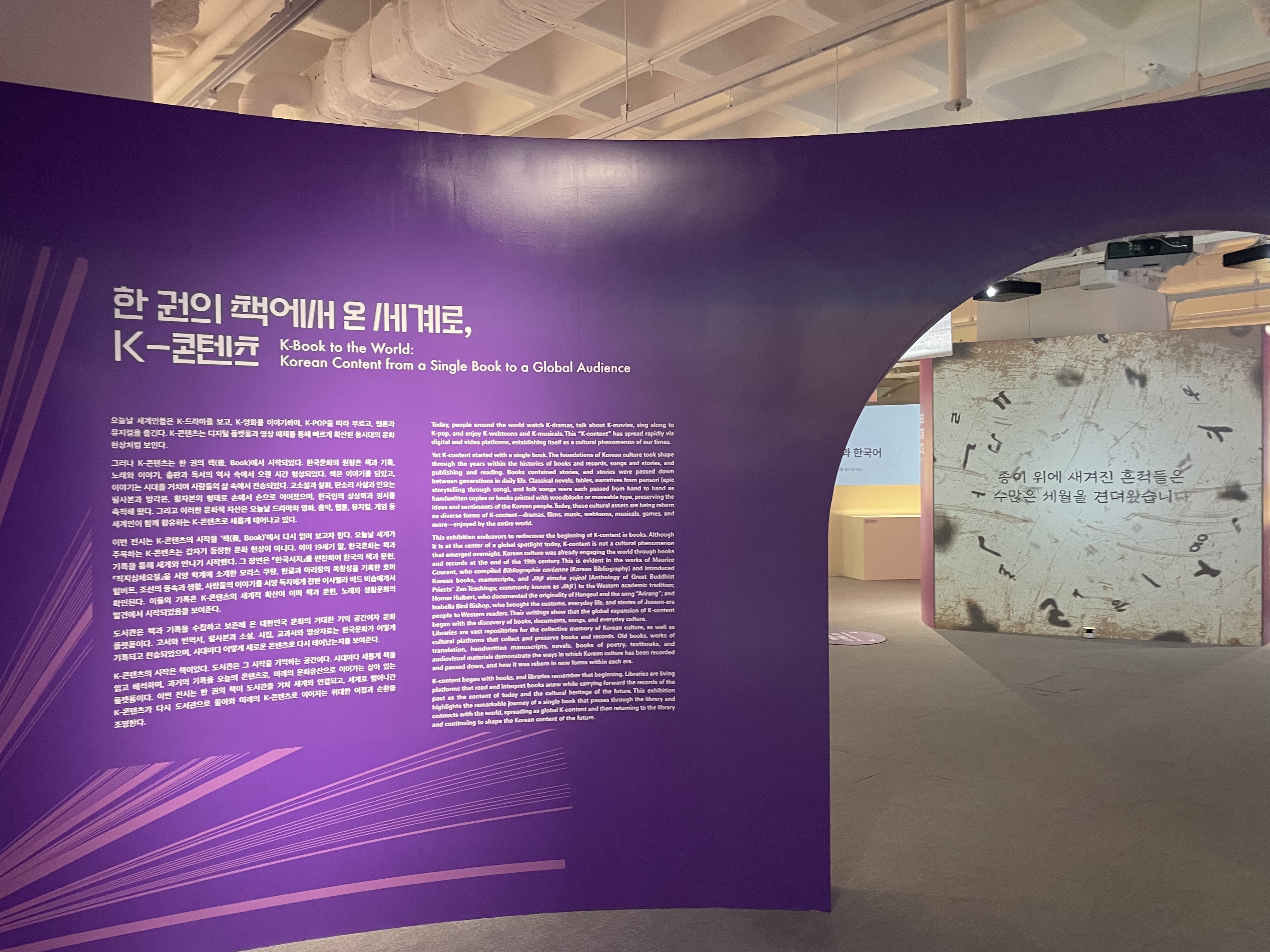
This is the entrance to the exhibition "From a Book to the World: K-Content," which runs through Oct. 6, at the first-floor exhibition hall of the National Library of Korea's main building in Seoul's Seocho-gu District.
By Lee Ji Yae
Photos = Lee Ji Yae
Korean content as showcased by K-pop, K-dramas and cinema has gone beyond Asia to evolve into a global cultural phenomenon. But how has such content captivated audiences around the world despite linguistic and cultural barriers?
Finding the answer in books and records, the National Library of Korea is holding through Oct. 6 the exhibition "From a Book to the World: K-Content" runs through Oct. 6 at the exhibition hall on the first floor of its main building.
Marking Busan's hosting of this year's World Library and Information Congress, the display systematically explores how stories and culture preserved in books and records have been reborn as contemporary content spread worldwide through translation.
One highlight is the event's second section, "From Stories to K-Content," which explores the cultural inspiration from traditional stories and folklore that inspired the hit Hallyu (Korean Wave) content of today.
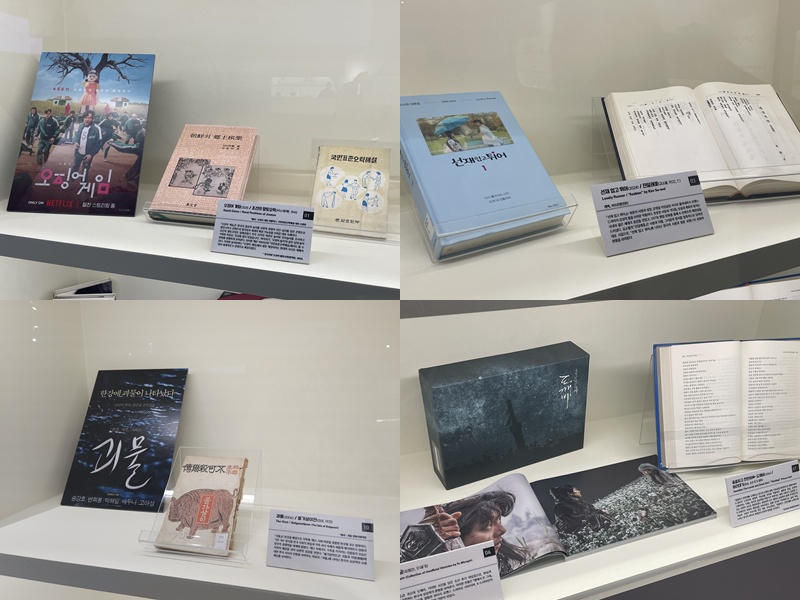
Highlights of the exhibition's second section, "From Stories to K-Content," include (clockwise from upper left) include "Squid Game" and "Rural Pastimes of Joseon"; "Lovely Runner" and "Azaleas" by Kim So-wol; "Guardian: The Lonely and Great God" and "Baridegi" (Princess Bari); and "The Host" and "Bulgasarijeon" (The Tale of Bulgasari).
The blockbuster Netflix series "Squid Game" is shown as a prime example of the fusion between traditional games and the universal human instinct of competition. Also on display is "Rural Pastimes of Joseon," a record of children's and folk games nationwide during the Japanese colonial period (1910-45).
Based on materials documenting the play culture of that era like the games Red Light, Green Light, biseokchigi (flying stone) and ojingeo nori (squid game), visitors can see how traditional games were adapted for use in contemporary content.
"Guardian: The Lonely and Great God" is also considered a benchmark in the reinterpretation of Korean mythology, folklore and traditional concepts of the afterlife. Built around the universal themes of immortality and salvation, the hit series resonated with viewers worldwide and its popularity extended to its soundtrack and tours of its filming locations.
The exhibition presents shamanistic myths such as "Baridegi" (Princess Bari) that highlight cultural archetypes surrounding the narratives of life and death, the afterlife and salvation that underpin the Korean-style fantasy of the drama.
The third section, "Translation and the Korean Language, K-content Expanding Across the World," features Korean literature that has reached readers worldwide through translation. Foreign-language editions of Han Kang's "The Vegetarian" and "Human Acts" and Chung Bora's "Cursed Bunny" show how Korea's distinctive memories, emotions and ways of thinking appeal to global readers regardless of culture.
The exhibition also stresses that this global exchange is far from recent. Foreign language textbooks from the Joseon Dynasty (1392-1910), for example, confirm Korea's long history of linguistic exchange with the outside world.
Thus the global spread of Korean content was made possible by translators who conveyed stories and emotions embedded in the Korean language across linguistic and cultural boundaries.
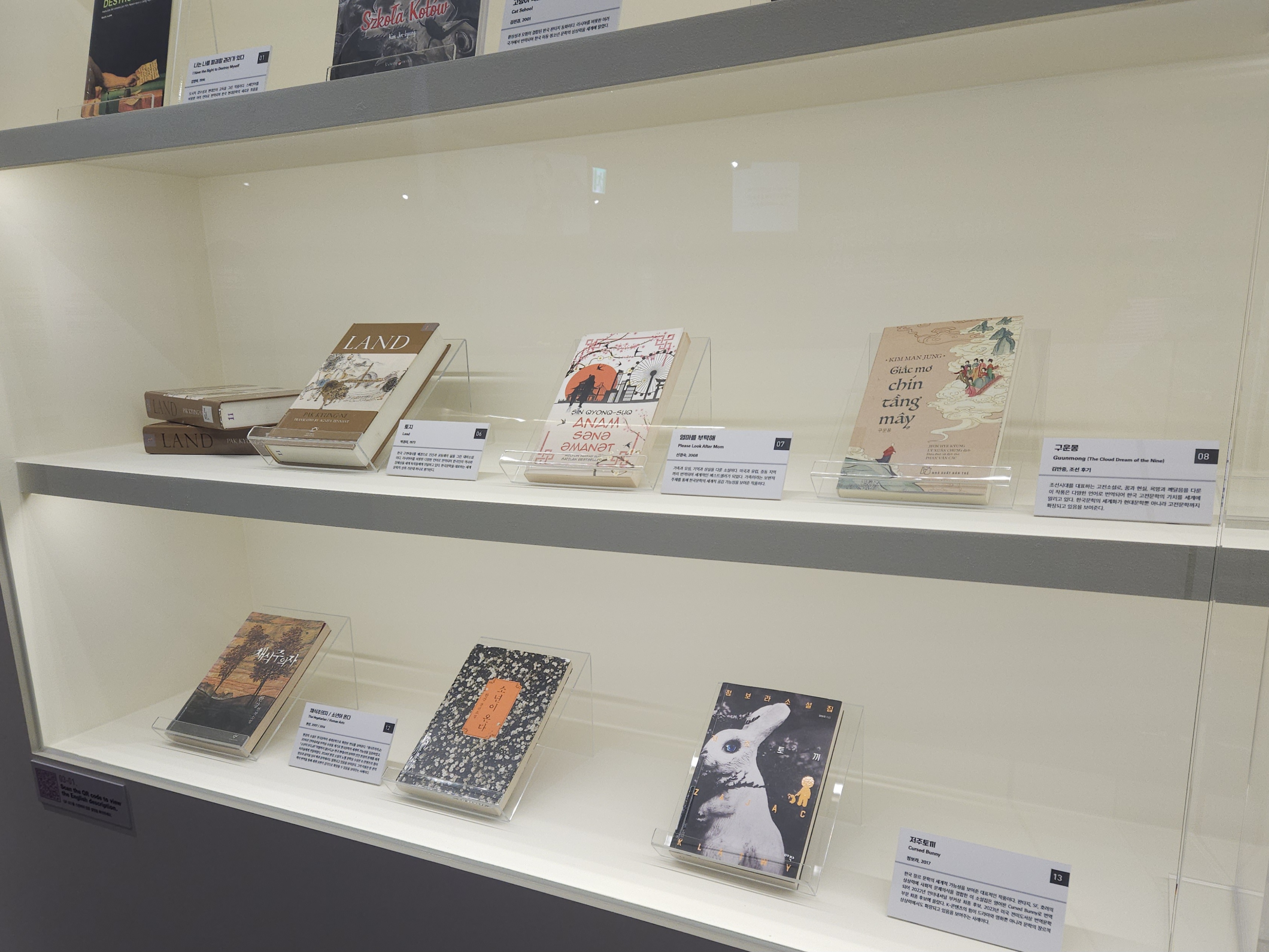
Displays at the section "Translation and the Korean Language, K-content Expanding Across the World" include (from upper left) "Land" by Pak Kyongni, "Please Look After Mom" by Shin Kyung-sook, "Guunmong" (The Cloud Dream of the Nine) by Kim Man-jung, Han Kang’s "The Vegetarian" and "Human Acts," and Chung Bora's "Cursed Bunny."
The exhibition's interactive experiences include an artificial intelligence-generated photo zone allowing visitors to assume the roles of characters from four eras, ranging from scenes from Joseon paintings to contemporary K-dramas.
Another area allows visitors to move a chip to see which countries operate Korean resource centers, host King Sejong Institutes, publish translations of Korean literature and offer Korean-language education.
Video installations featuring the traditional opera "Pansori Theater Chunhyang" of the National Changgeuk Company of Korea and Theater Hyunjang's open-air play "Euigi Nongae" show the rebirth of classic novels and legends through contemporary stage productions.
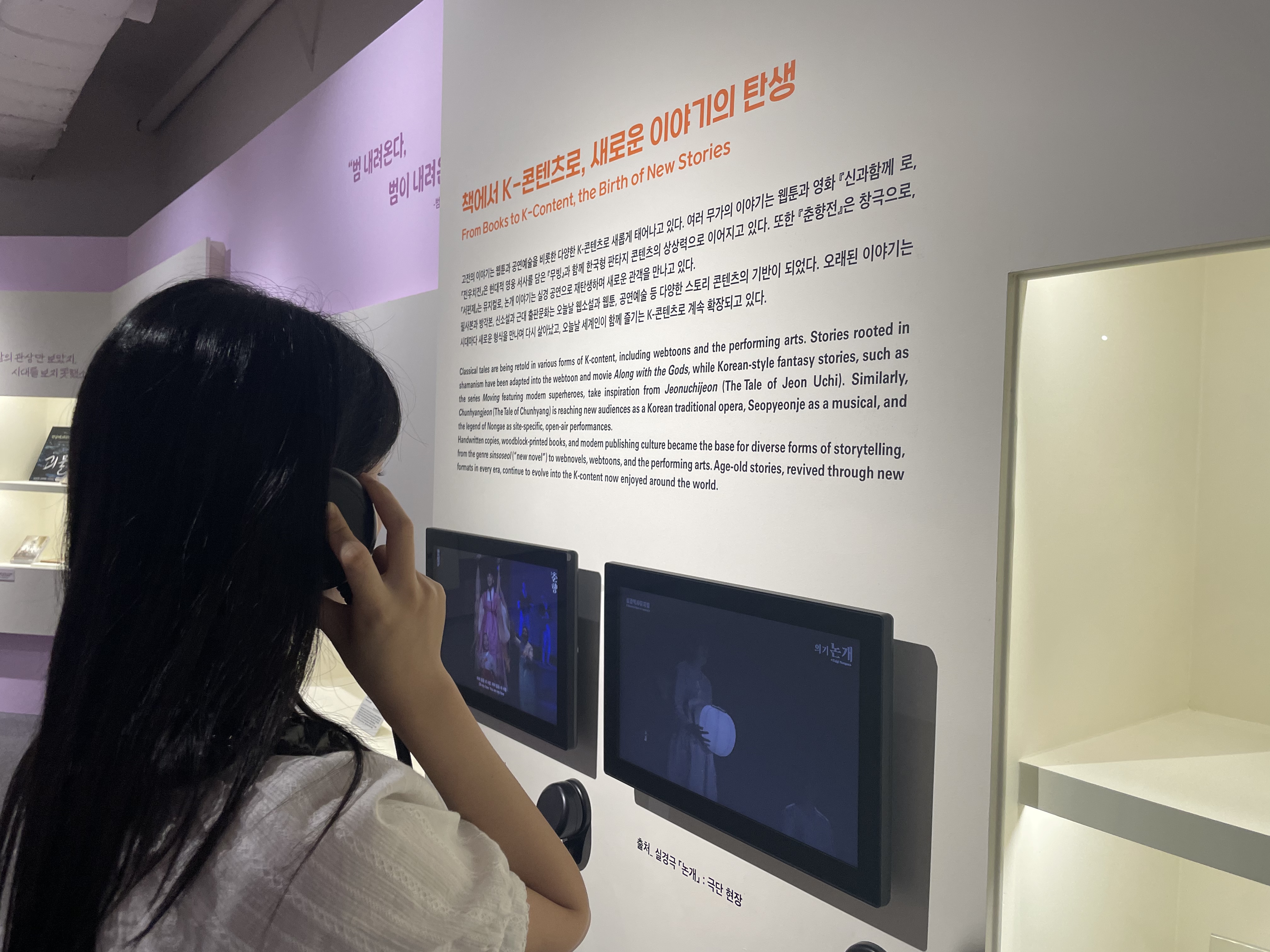
A visitor on Aug. 16 watches a video of the play "Euigi Nongae" by Theater Hyunjang at the exhibition "From a Book to the World: K-Content" at the first-floor exhibition hall of the National Library of Korea's main building in Seoul's Seocho-gu District.
RM, leader of K-pop supernova BTS, said in a 2023 interview with the major Spanish daily El Pais that the prefix "K" represents a "premium label" and "guarantee of quality" built by Korea's ancestors. The exhibition shows how the "K" in Korean content was not created overnight but originated from a long-standing accumulation of stories, culture and creative exchange.
ljyhwa@korea.kr
![[Global K-life] ⑤ Hallyu steering fans toward Korean literature](/upload/content/image/48c755c2a0004dd9bf72b99f1f28f3dd_20260728132541.jpg)
![[Global K-life] ② Fresh and innovative Korean cinema moves world](/upload/content/image/256fa4584e2d4f9a9b5912379086ddd0_20260731094007.jpg)
![[Global K-life] ① K-pop enters mainstream via connecting people](/upload/content/image/60d3becbd18543d69eec641f3b853485_20260706084227.jpg)