- 한국어
- English
- 日本語
- 中文
- العربية
- Español
- Français
- Deutsch
- Pусский
- Tiếng Việt
- Indonesian
This six-part Korea.net series is on the country's tentative list of World Heritage Sites to mark Busan's hosting in July this year of the 48th session of the UNESCO World Heritage Committee. This concluding sixth installment spotlights Archaeological Remains at the Hwaamsa Temple Site in Yangju, Gyeonggi-do Province.
By Hong Angie
Photos = Park Dae Jin
Video = Official YouTube channel of Hoeamsaji Museum of Yangju City
An expansive landscape warmly embraced by Cheonbosan Mountain, crystalline air and a stillness underscored only by the soft hum of insects in the grass. This type of serenity is rarely found amid the hustle and bustle of the city.
When entering the Hoeamsa Temple Site (Historic Site No. 128) nestled at the foot of Cheonbosan in Yangju, Gyeonggi-do Province, the area's unusual openness is striking. Instead of imposing wooden halls or brilliantly painted dancheong (traditional decoration), just boundless lawns and ancient foundation stones remain, silently holding their ground.
Slowly walking along the empty lot leads to the realization that the space where the buildings once stood is now filled with the traces of the long passage of time and nature. Imagining that a vast Buddhist temple once stood on this tranquil, empty site gives the landscape of the Hoeamsa ruins an entirely different character.
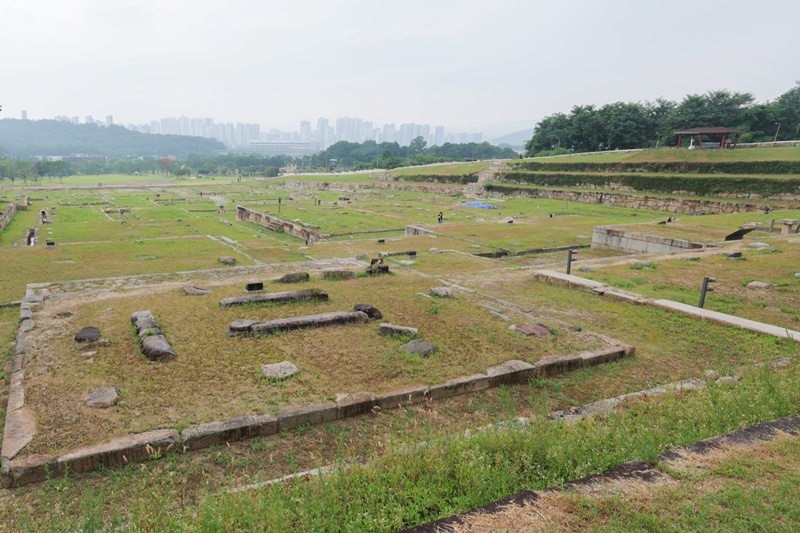
This is a panoramic view of the Hoeamsa Temple Site in Yangju, Gyeonggi-do Province. The cultural heritage zone there covers 33,391 square m and the cultural heritage protection zone 323,117 including the stupas and memorials of eminent monks.
Reaching the edge of the hill northeast of the site brings into view the sarira stupa (relic pagoda), a National Treasure that overlooks the vast landscape. The octagonal base is intricately carved with dragons, clouds and lotus flowers and the majestically rising finial, a decorative ornament marking the top, tip or end of an object or architectural structure, further accentuates the stupa's imposing presence.
This artifact represents the pinnacle of royal stone sculpture art from the early Joseon Dynasty (1392-1910). This stupa for housing relics alone is enough to suggest that Hoeamsa was no ordinary temple.
The true essence of this vast site is fully shown at the nearby Hoeamsaji Museum of Yangju City. The restored model on the first floor features stone blocks scattered across the floor, bringing to life a grand temple complex of 262 kan, with kan being a unit of measurement of the space between two columns, just as it was some six centuries ago.
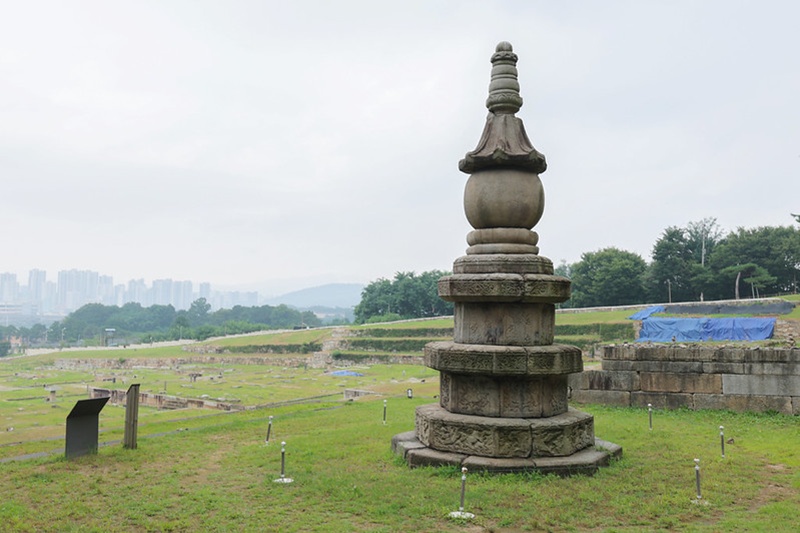
Yangju Hoeamsaji Saritap is designated National Treasure No. 2130.
A long-term excavation project starting in 1997 has brought the former status of Hoeamsa into even sharper focus. Artifacts unearthed include high-quality blue roof tiles previously used only for royal buildings, ornaments featuring dragon heads and water spouts that closely resemble palace architectural styles, and white porcelain statues of child monks.
Among these artifacts, the bronze geumtak (wind chime) most clearly illustrates the nature of the temple. Suspended from the eaves and producing a clear sound, the gong has an imposing size rarely seen at ordinary temples. Engraved on its surface are the names of Joseon royalty King Taejo, Queen Sindeok, Crown Prince Bangseok and the king's personal royal preceptor Muhak, along with a prayer for the well-being of the royal family.
Hong Bo Kyung, a curator and researcher with the World Heritage Promotion Team of the Culture and Tourism Division at Yangju City Hall, said, "Taken together, the exceptional size of the excavated gold bell, clearly inscribed names of royal figures on its surface and palace-style architectural remains conclusively prove that Hoeamsa was more than just a Buddhist temple; it was a royal summer palace where the king lived and conducted government affairs and a temple of the highest rank supported by the state."
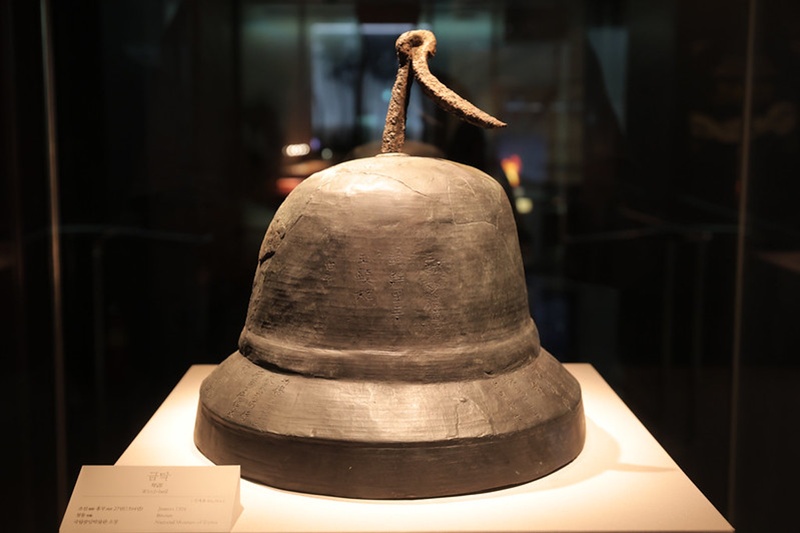
This large bronze geumtak (wind chime) was unearthed at the site of Bogwangjeon Hall at the ruins of Hoeamsa Temple. The surface bears a clearly engraved inscription of 134 characters including the names of King Taejo, Queen Sindeok, Crown Prince Bangseok and the king's personal royal preceptor Muhan, attesting to the elite status of the royal family and the temple in the early Joseon period.
The layout of the temple site also resembles that of Manwoldae, the royal palace of the Goryeo Dynasty (918-1392) now located in Gaeseong, present-day North Korea. Built on eight tiers of stone retaining walls along the slope of Cheonbosan, Manwoldae was the largest royal temple of the late Goryeo and early Joseon eras with some 70 buildings as well as the temporary palace of Taejo.
Yet even the grandeur of this massive royal temple was no match for the passage of time. After being destroyed by a fire in the 16th century, Hoeamsa remained in ruins.
Though the buildings were gone, the traces left underground did not disappear. Ondol, a traditional system of heated floors also called gudeul, and the sophisticated drainage structure are considered crucial evidence of the advanced architectural know-how of the era that supported the residence and Buddhist practice of thousands of monks.
The Hoeamsa Temple Site is an important archaeological area that shows the flourishing of East Asian seon (Zen) culture and the existence of large-scale meditation spaces between the late Goryeo and early Joseon periods of the 14th century. In recognition of its historical and archaeological significance, it was listed independently on the Korea Heritage Service's UNESCO World Heritage Priority List.
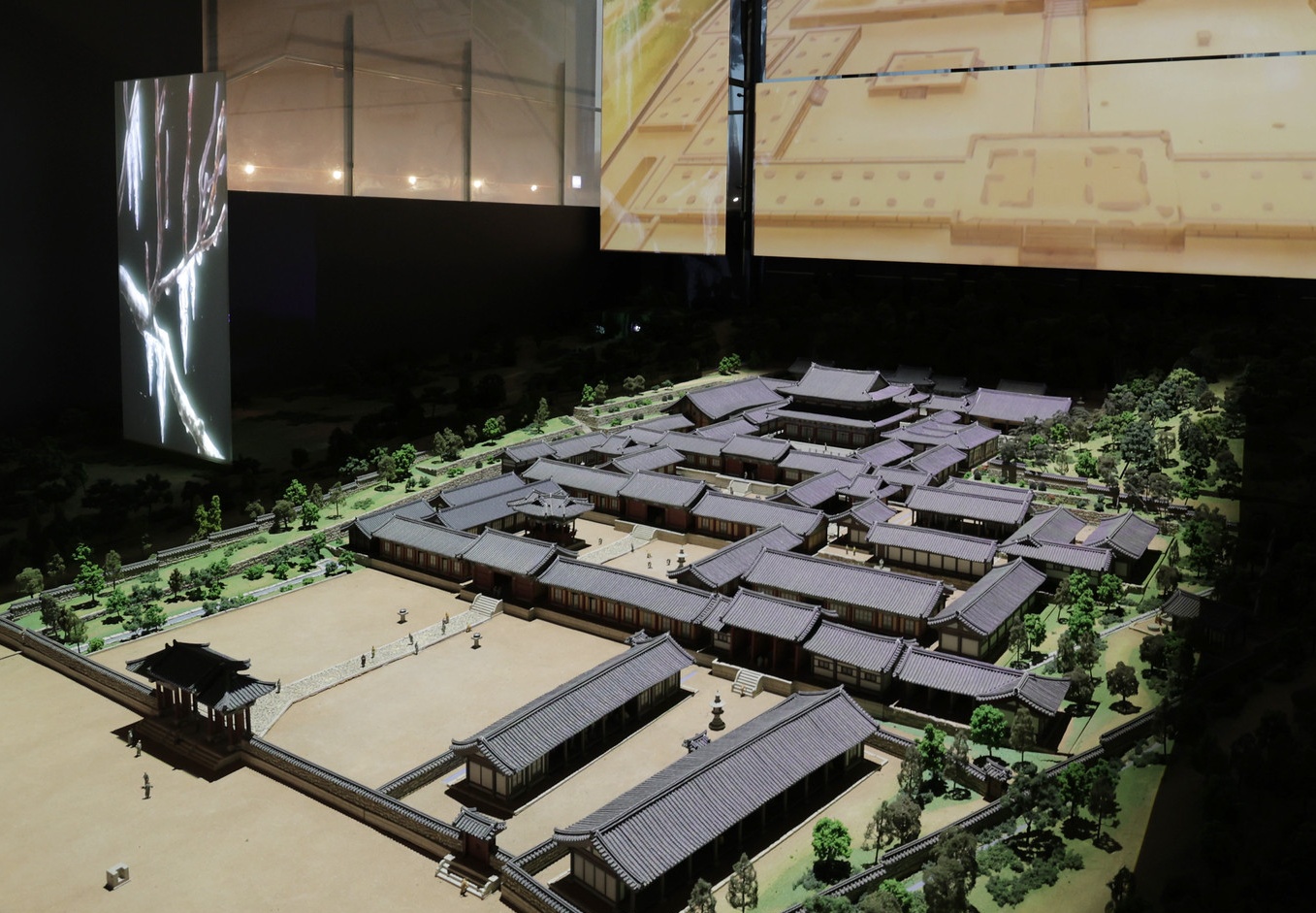
This is a scale model of the rebuilt Hoeamsa Temple on display at the Hoeamsaji Museum of Yangju City in Gyeonggi-do Province. It illustrates the temple's imposing grandeur at the time, with religious and monastic facilities and expansive living quarters arranged symmetrically along a north-south axis in a palace-style layout.
shong9412@korea.kr
![[World Heritage candidates] ⑤ Naganeupseong Walled Town](/upload/content/image/f940ba323f79426ab2cab557cf16a3eb_20260623084316.jpg)
![[World Heritage session in Busan] ④ Ancient tombs & fire festival](/upload/content/image/96c6907d8e7c4fd39daac6d622c7b452_20260728210605.jpg)
![[World Heritage session in Busan] ③ Photo essay of related events](/upload/content/image/8afd6581d01148138736d45fa9906d0b_20260727104912.jpg)
![[World Heritage session in Busan] ② Four coastal tidal flats added](/upload/content/image/c63e2920d30c483ba40b3d70f724b5c8_20260726123202.jpg)
![[World Heritage session in Busan] ① Enchanting K-Heritage House](/upload/content/image/f178972f05c043a8a5358eaffb78a8f4_20260723232819.jpg)