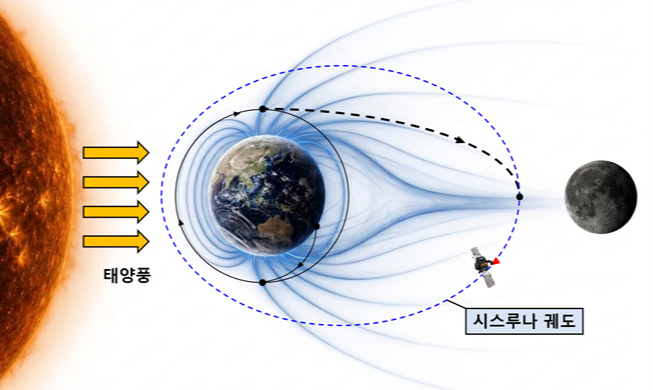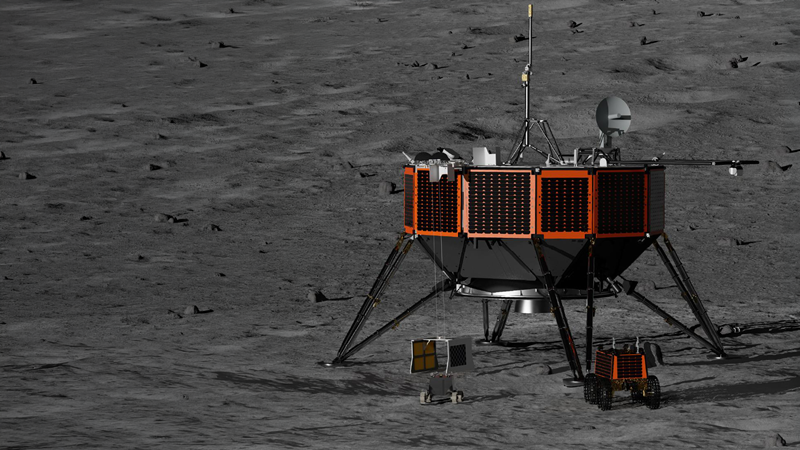
Illustration of CLPS CT-4 mission lunar lander (Korea AeroSpace Administration)
By Koh Hyunjeong
A homegrown lunar surface radiation detector as early as 2030 is set to head to the moon's south pole aboard a private NASA lunar lander.
The Korea AeroSpace Administration (KASA) on Aug. 17 announced its signing of an implementation agreement with NASA three days prior for the Lunar Surface Radiation Detector (LVRAD) to be carried on the lunar lander. KASA plans to complete development of a flight model by next year.
To assess the radiation environment on the lunar surface, LVRAD has a space radiation dosimeter and spectrometer for measuring radiation flux and a neutron spectrometer for measuring the neutron environment.
The observation data will be used to study the effects of radiation on the moon on astronauts and landers in manned and unmanned missions.
KASA Administrator Oh Taeseog said, "This implementation agreement is an opportunity to further strengthen cooperation between KASA and NASA on future lunar bases."
hjkoh@korea.kr