The government has announced it will expand global joint research and development projects on industrial technologies to encourage open innovation across the board.
On January 14, the Ministry of Trade, Industry and Energy (MOTIE) said it would make its support for global joint R&D projects more effective and diverse and drastically expand joint projects it funds along with foreign governments.
The ministry intends to invest KRW 51.5 billion into those R&D projects this year. The projects are designed to help Korean and foreign institutions jointly develop advanced technologies that are difficult to develop or acquire independently, and enter new markets. The ministry provides funds for many joint technology development tasks.
As part of the joint R&D projects, the ministry plans to create joint funds along with countries it signed memoranda of understanding (MOUs) with last year, including Germany, France and Switzerland. According to the MOUs, Korea agreed to conduct joint research into solar cells and medical technologies with Germany and to jointly develop digital healthcare, nano electronics and self-driving vehicles with France. Korea and China intend to develop biotechnologies and electronic components, while Korea and Israel plan to do research into information technology and unmanned aircrafts. Korea also agreed with Switzerland to develop advanced machinery.
The ministry intends to increase the number of countries with which it has similar partnerships to 10 or more by 2017, including Italy, with which it recently signed an MOU on technological cooperation. In addition, in order to lower barriers to entry into international joint R&D projects for domestic companies and academic and research institutions, it intends to not only provide funds for the projects but also to find valid tasks for joint R&D projects, to seek out overseas partners and to offer more information about technology trends.
Separately, an academia-industry research forum was launched on January 13 to respond to potential multilateral free trade agreements (FTAs) such as the Trans-Pacific Partnership (TPP).
In December 2013, Korea expressed its interest in joining the TPP, which currently covers 12 Pacific nations, including the U.S. and Japan. Since then, the Korean government has been analyzing the situation by industry and sector and has collected opinions during TPP explanatory meetings.
As TPP negotiations are expected to be concluded in the first half of this year, the government has realized the need to gather opinions from various professionals and to respond to the issue more aggressively. Thus, it launched the TPP Strategy Forum that consists of specialists from industry, academia and research institutions.
The forum consists of 15 professionals specialized in four areas: the economy and industry, politics and international relations, trade law and individual nations. The ministry also intends to create a pool of professionals so that specialists from various fields can flexibly participate in the discussions.
By Limb Jae-un
Korea.net Staff Writer
Photos courtesy of the MOTIE
jun2@korea.kr

On January 14, the Ministry of Trade, Industry and Energy (MOTIE) said it would make its support for global joint R&D projects more effective and diverse and drastically expand joint projects it funds along with foreign governments.
The ministry intends to invest KRW 51.5 billion into those R&D projects this year. The projects are designed to help Korean and foreign institutions jointly develop advanced technologies that are difficult to develop or acquire independently, and enter new markets. The ministry provides funds for many joint technology development tasks.
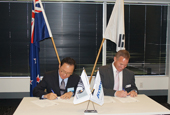
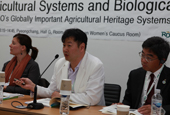
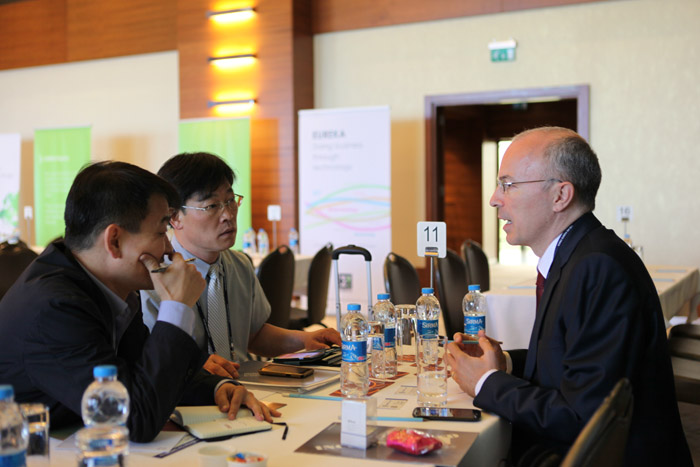
Domestic and foreign officials discuss cooperation on international joint R&D projects.
As part of the joint R&D projects, the ministry plans to create joint funds along with countries it signed memoranda of understanding (MOUs) with last year, including Germany, France and Switzerland. According to the MOUs, Korea agreed to conduct joint research into solar cells and medical technologies with Germany and to jointly develop digital healthcare, nano electronics and self-driving vehicles with France. Korea and China intend to develop biotechnologies and electronic components, while Korea and Israel plan to do research into information technology and unmanned aircrafts. Korea also agreed with Switzerland to develop advanced machinery.
The ministry intends to increase the number of countries with which it has similar partnerships to 10 or more by 2017, including Italy, with which it recently signed an MOU on technological cooperation. In addition, in order to lower barriers to entry into international joint R&D projects for domestic companies and academic and research institutions, it intends to not only provide funds for the projects but also to find valid tasks for joint R&D projects, to seek out overseas partners and to offer more information about technology trends.
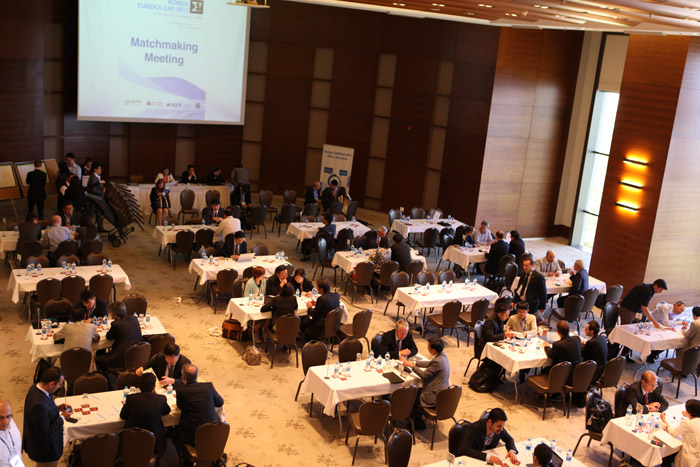
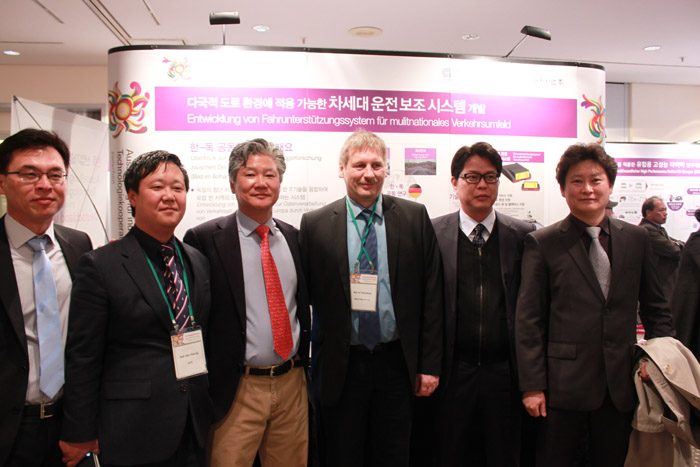
Korean and German officials participate in an exhibit of next-generation driving assistance systems developed through joint research, in March 2014.
Separately, an academia-industry research forum was launched on January 13 to respond to potential multilateral free trade agreements (FTAs) such as the Trans-Pacific Partnership (TPP).
In December 2013, Korea expressed its interest in joining the TPP, which currently covers 12 Pacific nations, including the U.S. and Japan. Since then, the Korean government has been analyzing the situation by industry and sector and has collected opinions during TPP explanatory meetings.
As TPP negotiations are expected to be concluded in the first half of this year, the government has realized the need to gather opinions from various professionals and to respond to the issue more aggressively. Thus, it launched the TPP Strategy Forum that consists of specialists from industry, academia and research institutions.
The forum consists of 15 professionals specialized in four areas: the economy and industry, politics and international relations, trade law and individual nations. The ministry also intends to create a pool of professionals so that specialists from various fields can flexibly participate in the discussions.
By Limb Jae-un
Korea.net Staff Writer
Photos courtesy of the MOTIE
jun2@korea.kr