The country's public administration model is rising in global prominence. The Ministry of the Interior and Safety in December last year presented benchmarks of public sector innovation to diplomatic delegations from 93 countries, promoting the potential of Hallyu (Korean Wave) in public administration. This series covers five examples of such advances ranging from disaster management and smart agriculture to reforestation and the construction of administrative cities.
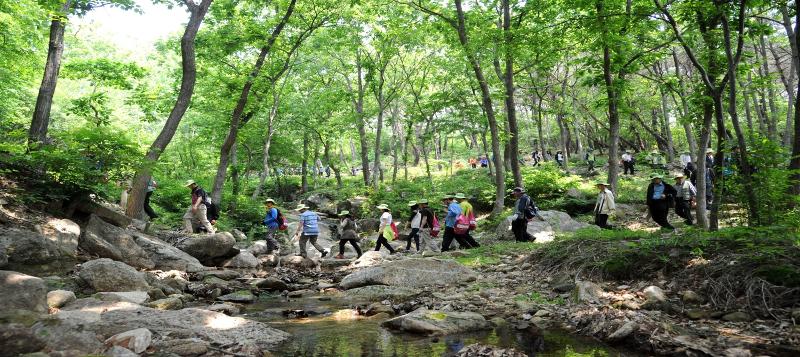
Hikers walk along the Dullegil trail of Jirisan Mountain spanning the provinces of Gyeongsangnam-do and Jeollabuk-do.
By Margareth Theresia
Photos = Korea Forest Service
Korea is widely known abroad as a nation with lush forests and enchanting mountain landscapes.
In major cities including Seoul, green mountain slopes accessible to the public daily form layers upon layers to create picturesque views. This scenery is no coincidence but the cumulative result of systematic policy toward national reforestation.
The process of achieving these results was far from smooth. The land was devastated by exploitation during Japanese colonial rule and bombing during the Korean War (1950-53). Right after the war ended, nearly half of the country's mountains were turned into barren hills, making it difficult to find even a single tree.
The volume of timber, or that of trees, was a mere 36 million cubic meters, the lowest since nationwide forest statistics were first compiled in 1927.
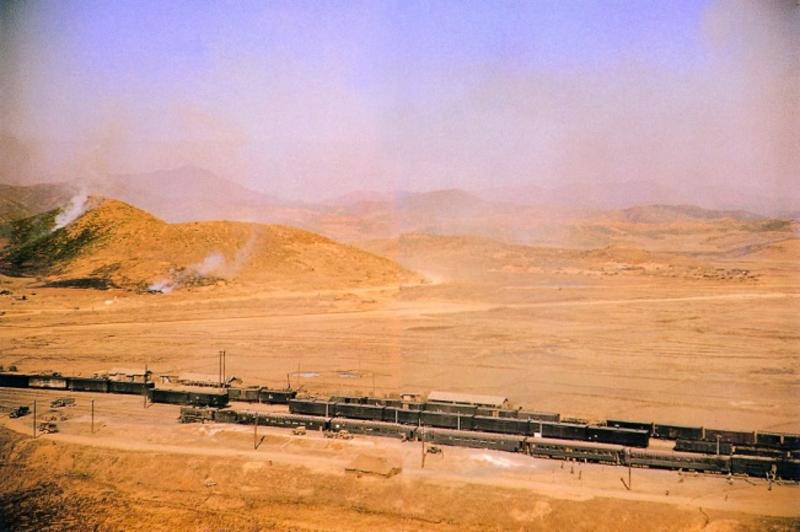
Shown is the area around Munsan Station in Paju, Gyeonggi-do Province, in the 1960s, when the region had almost no trees.
Between the 1970s and 80s, the government enforced a strong reforestation policy. With economic growth leading to a shift in household fuel from firewood to fossil fuels, the practices of indiscriminate logging and slash-and-burn agriculture began to plummet.
A turning point in forest recovery came through the parallel implementation of large-scale afforestation projects and strict rules on forest protection.
A turning point for forest recovery was reached as large-scale afforestation projects were carried out in parallel with strict forest protection policies. As a result, as of 2020, timber volume jumped to approximately 29 times that of 1953, punctuating Korea's status as a global model for rapid reforestation that exceeded the level of a developing country.
Resident participation centered on regional forestry organizations was also a major factor behind the success of reforestation. Within half a century, the volume of trees shot up 15 times and that of forest resources jumped from 10 cubic meters per hectare in 1972 to 165 in 2020, an amazing 28-fold growth over more than six decades.
Based on this outcome, the country joined the ranks of advanced reforestation states, rising from the ashes of a developing country devastated by civil war.
Today, Korea is a leading forest country where trees account for about 63% of national territory. This figure is more than double the world average of 31%, and the nation's forest ratio ranks fourth among member states of the Organisation for Economic Co-operation and Development.
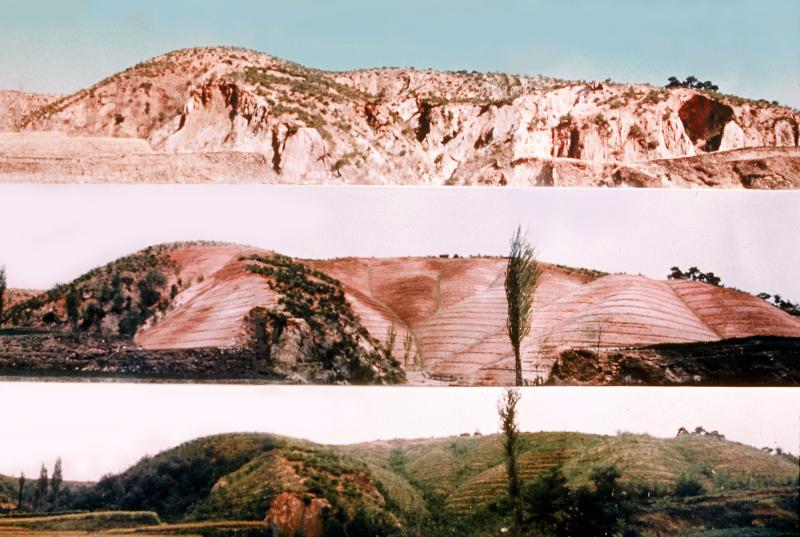
Registered as a UNESCO Memory of the World, these photos show the process of reforestation from 1973-77 in areas surrounding Yeongilman Port in Pohang, Gyeongsangnam-do Province.
Korea's experience and achievements in this sector were compiled into records of reforestation that received global recognition for their universal value. Documenting the process of restoring national territory devastated by the Korean War through cooperation between the public and private sector, the records in April last year were designated World Memory of the World at UNESCO's executive board meeting in Paris.
The combined 9,619 original documents include afforestation registers, policy documents, tree cultivation records as part of the Saemaul Undong (New Community Movement), aerial photographs and flood prevention materials. They were praised for high value in history and policy, covering not only the reforestation process but also the entire system of environmental management such as responding to forest fires and landslides.
These archives are an iconic example of public-private cooperation that produced results. They are now expected to see wide use as an asset for international cooperation such as in training officials in developing countries or providing official development assistance in forestry.
They are also considered a common policy indicator for humanity for taking on global environmental issues including responses to climate change, prevention of desertification and restoration of forest ecosystems.
margareth@korea.kr
![[Public admire-stration] ③ AI eases labor shortage at farms](/upload/content/image/a8db1df91e754df3a35cc19b9c82956b_20251212132054.png)
![[Public admire-stration] ② AI-based disaster response system](/upload/content/image/800fef48140642be8710278532ffb865_20260312082356.jpg)
![[Public admire-stration] ① Detecting potential, hidden disasters](/upload/content/image/38ceae8af2704a64b95c13822897ed16_20251210100934.jpg)