- 한국어
- English
- 日本語
- 中文
- العربية
- Español
- Français
- Deutsch
- Pусский
- Tiếng Việt
- Indonesian
By Hong Angie
In an era where the financial burden of marriage and housing holds young people back, the central and local governments are offering more support to encourage matrimony.
The scope of assistance is expanding, ranging from a traditional focus on housing subscriptions and loans to initial marriage expenses and overall livelihood stability.
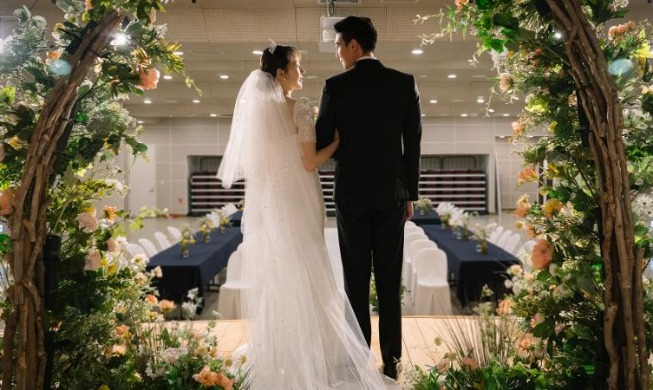
Public venues, small weddings cut financial burden
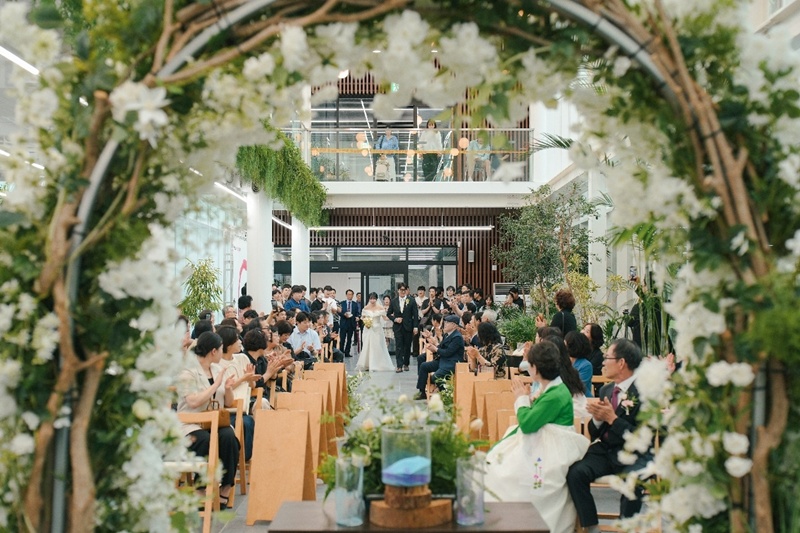
The first couple of the program "U:ON Wedding" gets married on June 7 at the Ulsan Garden Support Center in Ulsan. (Ulsan City Hall)
As wedding options for engaged couples increase, demand for small weddings that place practicality over lavishness is gradually rising. Local governments have opened public facilities and offered customized packages for weddings to ease the financial burden.
At the heart of this cost-cutting movement is the program "U:ON Wedding" of the southern coastal city of Ulsan, which bundles in one package the venue, attire, makeup and decorations. This has been well-received by couples seeking to tie the knot, with the program's first couple on June 7 saying "I do" at the Ulsan Garden Support Center.
Demand for more practical weddings is spreading across the country. Seoul, with its "My Own Wedding" program, and the provinces of Gyeonggi-do and Gyeongsangnam-do have opened historic public facilities and outdoor gardens as matrimonial venues.
Local governments also seek to reduce high wedding costs through standardized package support.
Special housing allocation, public rental housing for newlyweds
Stronger housing assistance is helping young couples hesitant to marry due to housing costs. A key public initiative for housing stability is the special housing allocation for newlyweds.
This system sets aside a portion of the available apartment lottery pool as an "exclusive reservation" for newlyweds. Typically, getting a new apartment favors applicants who are older, have held a housing subscription savings account for a long time or have many dependents.
Allocation of a share of both public and private housing supply for newlyweds drastically raises the prospects of young couples, who often lack the necessary points for selection.
The results are backed by statistics. The Korea Real Estate Board said that among 14,241 successful applicants nationwide in the first quarter, those in their 30s or younger comprised 58% (8,266), or roughly 60%. This is thanks to half of the supply of private apartments and as high as 80% of public housing being in the special allocation program, fueling higher participation by young people, especially in programs that require fewer points.
Another initiative is the expansion of public rental housing at rates below market value through programs like "Happy Housing" and Newlywed Hope Town." These have recently evolved to prioritize households with children in line with measures to raise the low birth rate.
For instance, Pohang, Gyeongsangbuk-do Province, will collaborate with the provincial government and Gyeongbuk Development Corp. to supply 100 units of public rental housing in the Songdo-dong and Ocheon-eup areas. The dual objective is revival of the original city center through attraction of a younger population and housing stability.
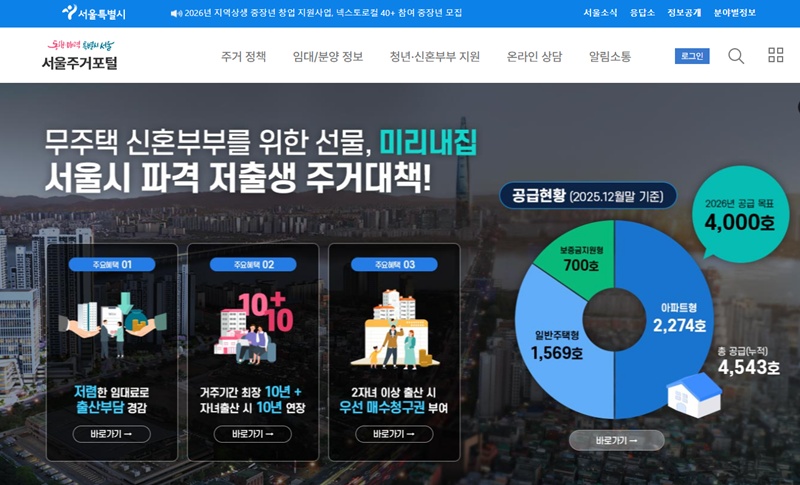
This graphic shows housing support customized for newlyweds and young adults as displayed on the Seoul Housing Portal. (Screen capture from portal's official website)
Easing burden of housing loans, providing cash support
Financial and cash-based support has been strengthened to alleviate soaring monthly rent and instability in the jeonse (lump-sum deposit lease) market. To ensure housing stability for young adults who do not own homes, the Seoul Metropolitan Government has lowered the eligibility requirements for its program to help youth with monthly rent.
The city has removed blind spots by expanding the scope of beneficiaries from single-person households to childless newlyweds, young single-parent families and young victims of jeonse fraud.
The loan types beotimmok to help with jeonse deposits and didimdol for home purchases offer interest rates lower than those of the market. Newlyweds also receive preferential interest rates to reduce their interest payments.
Local governments are also offering cash-based support. Daejeon, the country's No. 5 city, grants up to KRW 5 million in marriage incentives to young newlyweds, while Jindo-gun County, Jeollanam-do Province, provides up to KRW 3 million. Gunpo in Gyeonggi-do subsidizes a portion of outstanding jeonse or monthly rental deposit loans, covering housing costs of up to KRW 3 million per household.
From walking down the aisle to securing a first home, a growing array of central and local government support is helping young couples more confidently take on life's biggest milestones.
shong9412@korea.kr
![[K-matrimony] ② Evolution of wedding customs reflects era's traits](/upload/content/image/750fdf3a7e4b4b8d9a31124a5ebcbc2b_20260528101522.jpg)
![[K-matrimony] ① Tradition of uniting families, not just spouses](/upload/content/image/1791ba3de1fe429ea01ef6aa5542b19f_20260526131521.png)