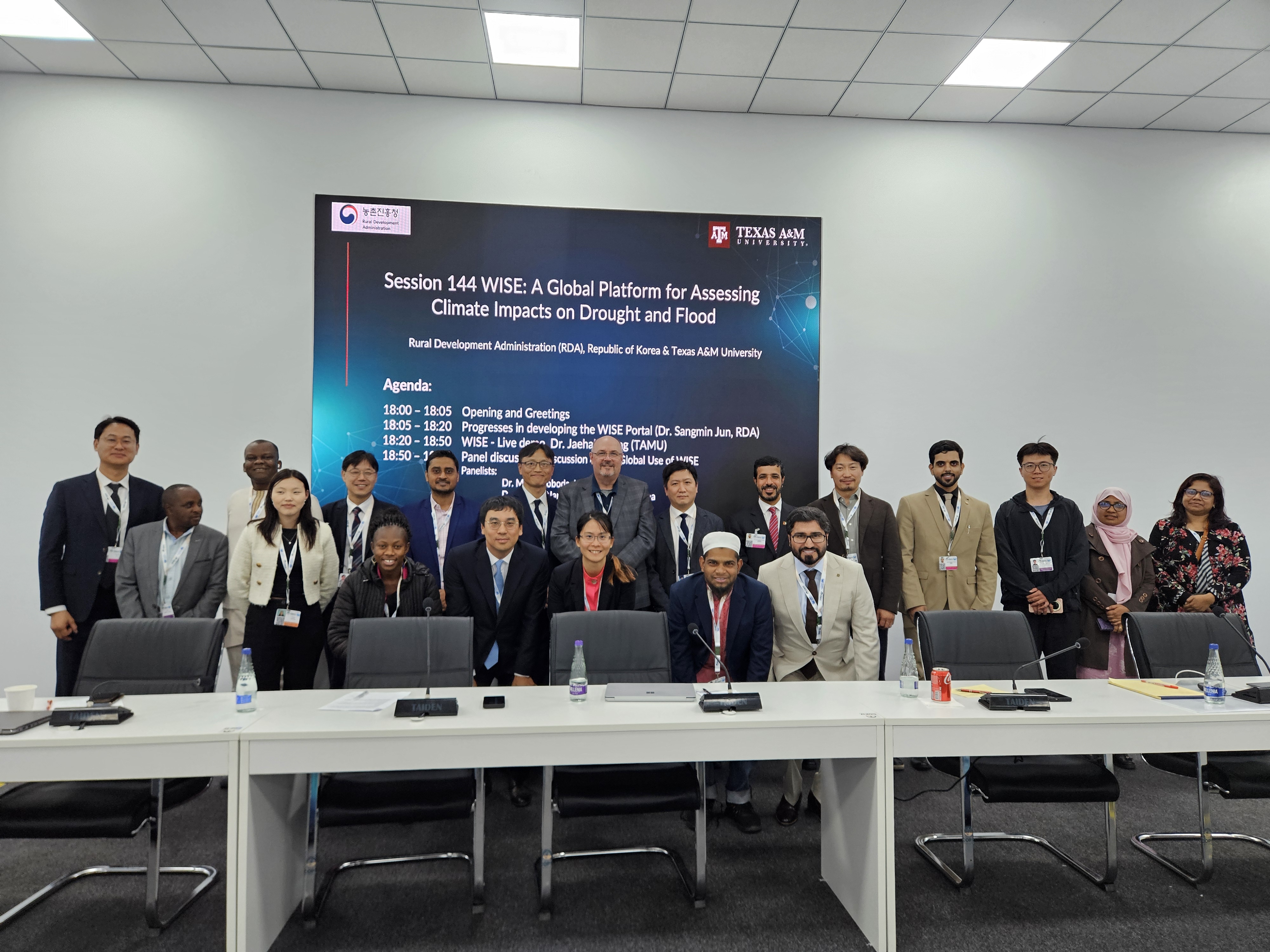
The Rural Development Administration (RDA) introduced its Water, Impact and Sustainability Estimator, a homegrown platform jointly developed with Texas A&M University of the U.S. for data on the impact of flooding and droughts abroad, from Aug. 18-21, at the Conference of the Parties to the United Nations Convention to Combat Desertification in Ulaanbaatar, Mongolia. (RDA)
By Lee Ji Yae
The Rural Development Administration (RDA) has unveiled to the world introduced its domestically developed Water, Impact and Sustainability Estimator (WISE), a digital platform for information on the impact of flooding and droughts abroad.
The RDA on Aug. 23 said it unveiled WISE, which it jointly developed with Texas A&M University of the U.S., at the 17th Conference of the Parties to the United Nations Convention to Combat Desertification (UNCCD) from Aug. 18-21 in Ulaanbaatar, Mongolia.
WISE allows web users worldwide to analyze water use conditions and the risks of drought and flooding in agricultural areas. The platform provides information that policymakers and researchers can use to proactively identify water shortages and disaster risks in farming regions caused by climate change and devise adaptation policies.
On the sidelines of the general assembly, Jeon Sangmin of the RDA's National Institute of Agricultural Sciences gave a presentation on the development process of WISE and its service. Texas A&M professor Chung Jaihak also demonstrated the platform's key features and how to use them.
The RDA plans to officially register and add WISE to the UNCCD's Drought Toolbox. Based on this, the agency will expand global cooperation to enable the use of homegrown agricultural data for country-specific drought management, projections for climate change impact, vulnerability assessments and sharing of best practices for risk reduction.
Choi Kwang-ho, director general of the RDA's Technology Cooperation Bureau, said, "We will continue raising our cooperation with international organizations and research institutions abroad to ensure that our agricultural technology offers tangible benefits to global agriculture."
ljyhwa@korea.kr