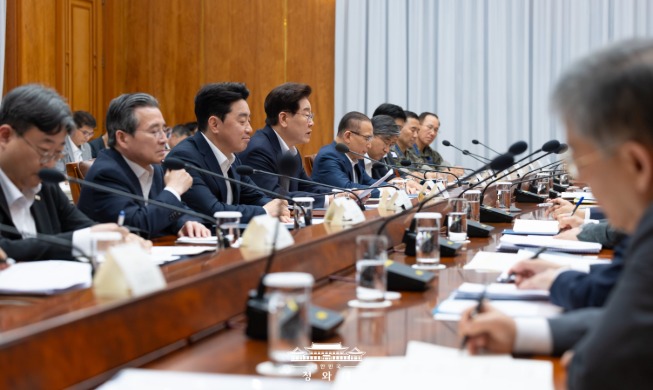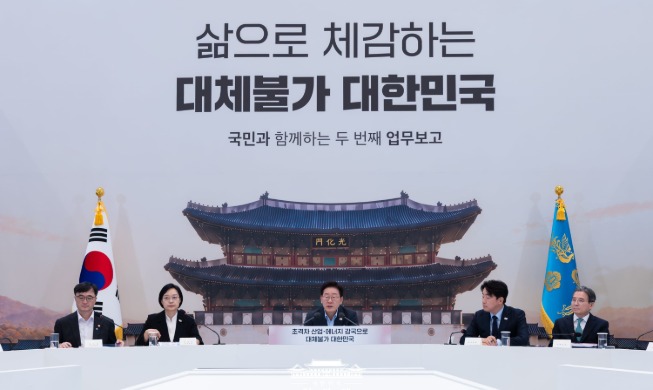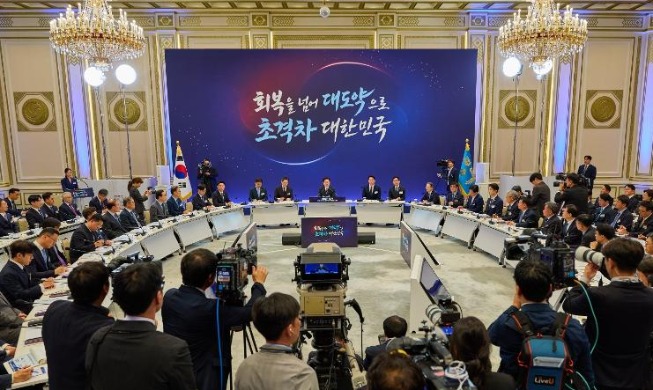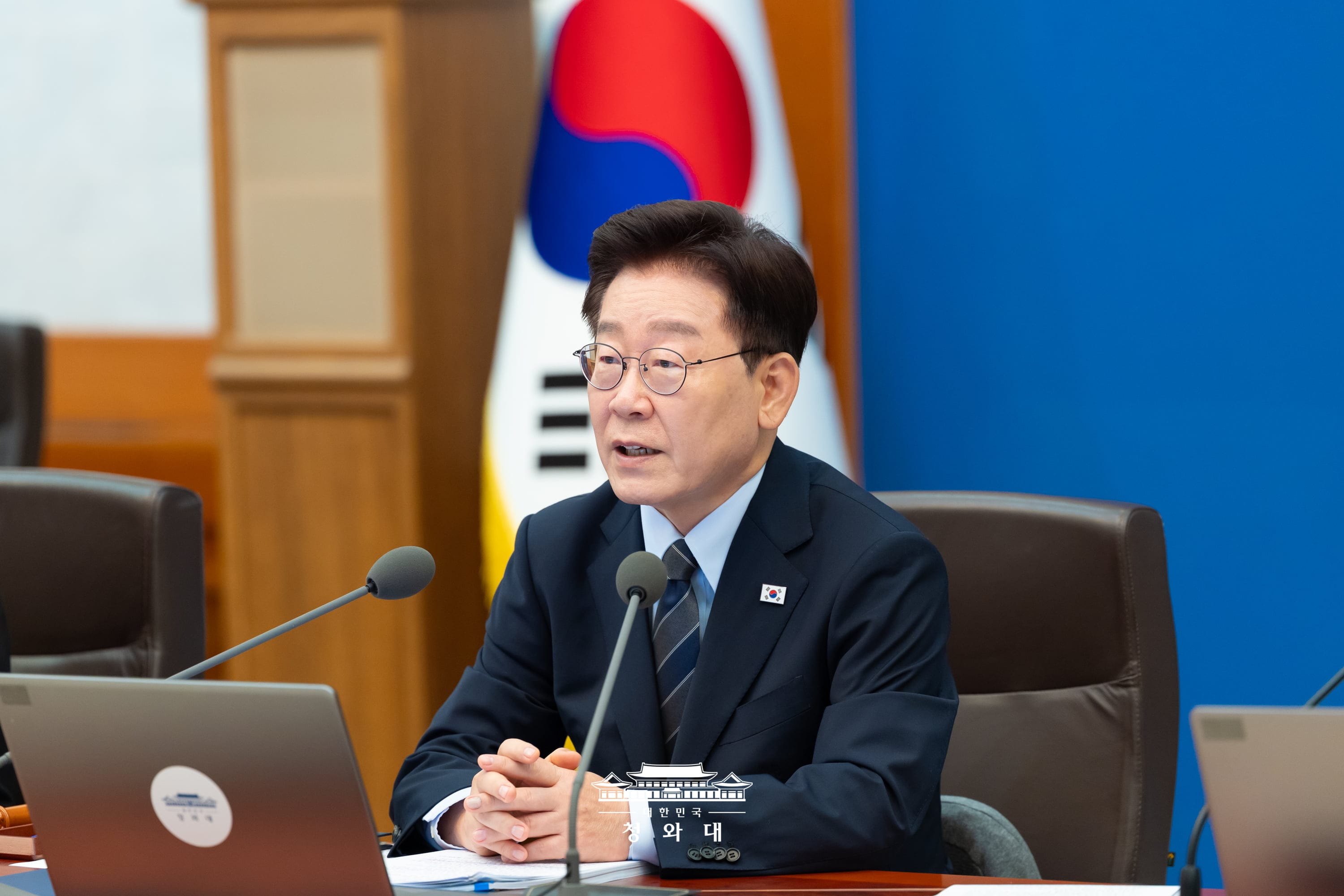
President Lee Jae Myung on Sept. 1 speaks at a Cabinet meeting held at Cheong Wa Dae in Seoul's Jongno-gu District. (Cheong Wa Dae)
By Xu Aiying
The 2027 government budget is set at a record-high KRW 820.9 trillion, up 12.8% from this year's, another all-time high.
A Cabinet meeting on Sept. 1 approved the 2027 budget bill and the 2026–30 national fiscal management plan at Cheong Wa Dae.
The bill was designed to focus on setting a "virtuous fiscal cycle driven by growth" through record-breaking investment in five areas: the government's three megaprojects and artificial intelligence (AI); future growth engines; comprehensive support for youth at each development stage; tackling income polarization and fostering inclusive growth; and public safety and peace.
Overall fiscal management will undergo an overhaul. A "future preparedness fund" worth KRW 162.3 trillion will allocate KRW 45.4 trillion in four key areas -- youth, growth engines, regional communities, and education and talent -- all factors behind raising the economy's potential growth rate.
Another KRW 21.3 trillion -- a 97.2% jump -- will support the three megaprojects and support for AI, with KRW 3.4 trillion to help maintain the country's "super-gap" in semiconductor competitiveness as a global power in the field.
In addition, KRW 41.4 trillion will go toward development of post-semiconductor and advanced strategic sectors by expanding future growth engines. Moreover, KRW 15 trillion is earmarked to build on the country's semiconductor boom by supporting 10 next-generation strategic high-tech sectors including nuclear fusion, small modular reactors, quantum computing, aerospace and advanced biotechnology.
Another KRW 8 trillion will help train high-tech talent and strengthen AI capacity of youth to provide them with comprehensive support customized for each development stage.
Driving a major transformation of domestic territory and region-led growth will get KRW 33 trillion, more than double the previous figure. And KRW 1.3 trillion will expand support for essential healthcare in the provinces, including the launch of a "growth engine special subsidy" and a new program for filling in the gaps in medical service through region-led initiatives.
To ensure a smooth transfer of wartime operational control from the U.S. within the incumbent president's term, the budget will support the acquisition of key military assets such as nuclear-powered submarines and KF-21 fighter jets. The treatment of service personnel and veterans will receive a boost through improvement of the working conditions of junior officers and a hike in the honorary allowance for war veterans.
The budget bill will be submitted on Sept. 3 to the National Assembly.
xuaiy@korea.kr