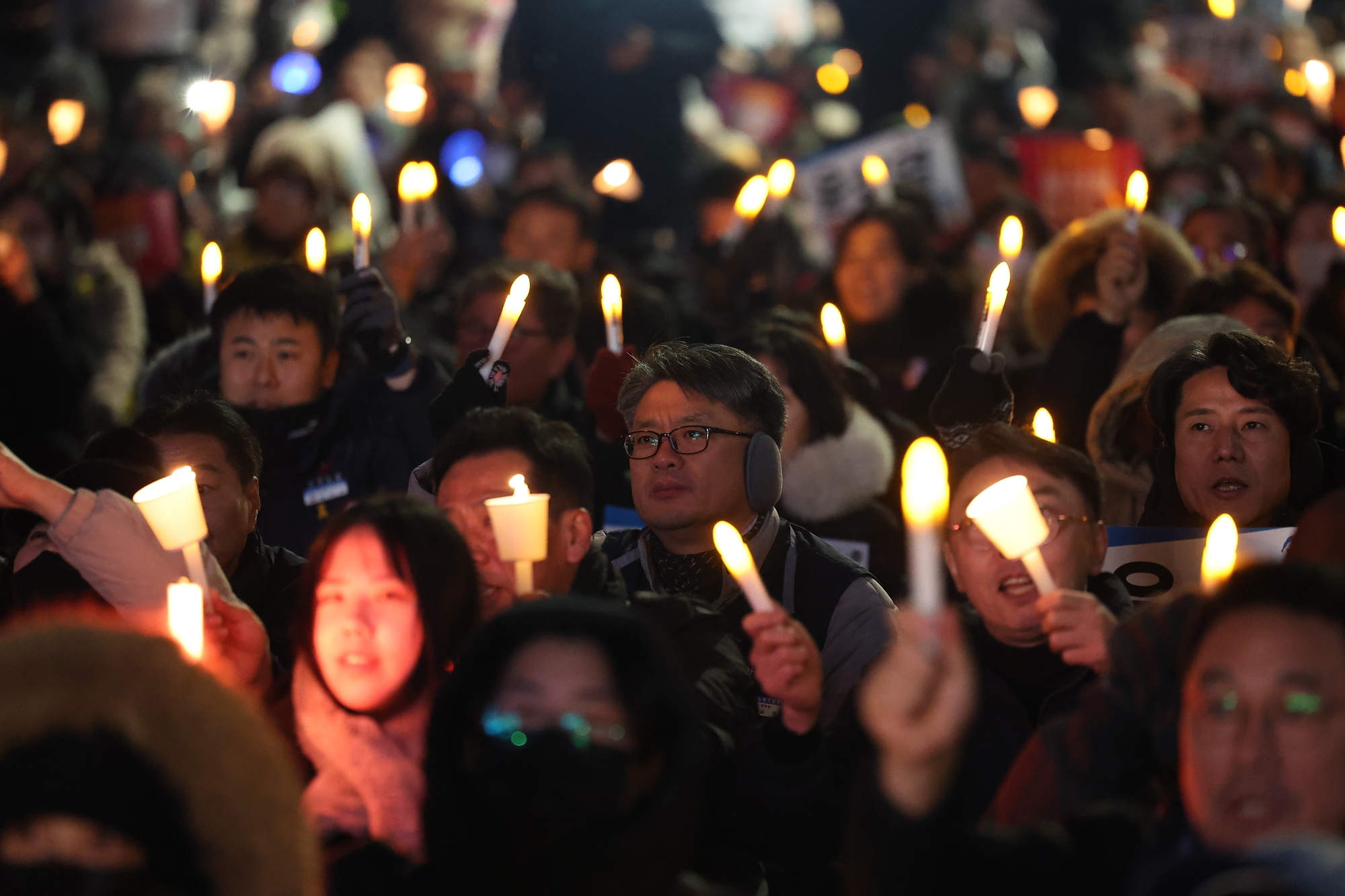
The Korean people in February this year were nominated for the Nobel Peace Prize for stopping the martial law attempt of Dec. 3, 2024. Shown is a candlelight vigil on Dec. 6, 2024, near National Assembly Station in Seoul's Yeongdeungpo-gu District demanding the impeachment of then President Yoon Suk Yeol. (Yonhap News)
By Lee Keunse, professor of philosophy
Dept. of General Education, Kookmin University
In early February this year, the country's "Citizen Collective" was nominated for the Nobel Peace Prize. Political scientists worldwide agreed that the people's journey of resolving the constitutional crisis dubbed the "Dec. 3 emergency martial law" through civic solidarity and legal and institutional procedures was a global model, recommending the Korean public as a candidate to the Nobel Committee. Regardless of external achievements such as this, the incident is an occasion for Koreans to face the vulnerabilities hidden behind procedural democracy and reflect on the underlying aspects of their political culture.
As a historical community, the Republic of Korea has repeatedly faced the danger of totalitarianism seeking to subordinate the individual to the state, enduring the oppression of Japanese colonial rule, the Korean War and military dictatorships. The martial law incident of Dec. 3, 2024, went beyond regression to authoritarianism by recalling the specter of totalitarianism lurking in history.
Pluralism, the basis for a liberal democracy, is a perspective that pursues the multi-dimensionality of society through the right to differences, tolerance for conflict, and diversity of thought and art. It views conflict arising from dialogue as possessing public utility rather than the tranquility achieved through the control of thought and language.
The masterminds of the incident, however, could not tolerate pluralism, which appeared inefficient on the surface, and sought to eliminate opposing voices through force as if they held sole legitimacy. The ban on legislative and political party activities and control of expression specified in the Martial Law Command Proclamation were symptoms of a totalitarian ideology that considers the state as the absolute authority and eliminates pluralism.
Standing on the brink of regression into authoritarianism, "K-democracy" wisely overcame the crisis of a suspension of the constitutional order to take another step forward. The entire series of events, ranging from the initial civic rallies to the National Assembly's passage of a resolution demanding the lifting of martial law, impeachment of the president, the Constitutional Court's upholding of the motion, and finally a snap presidential election and regime change was thoroughly grounded in institutional procedures.
Subsequently, judicial actions were taken against the incident's ringleaders and national governance regained stability. This journey proved how the spirit of democracy is deeply embedded in the Korean people and that "procedural democracy" is firmly functioning in the country.
Learning from totalitarian tendencies that have laid dormant in history as a cautionary tale, the country must examine if the environment for pluralistic democracy -- that is, a "cultural dimension" -- is established throughout society. Democracy demands a "forum for genuine debate" on the direction of the community, needing more than just institutional mechanisms that limit the abuse of power. Human behavior lacks any absolute certainty shared by all; rather, there is always room for the unknown, conflicting opinions and diverse judgments.
Democracy requires the difficult task of reconciling conviction and uncertainty. Yet a community enjoys dynamism when a belief is considered just one opinion among many and when diverse ways of thought are discussed alongside historicity.
Likewise, when a government acknowledges a forum for open discussion within the community, this builds the foundation for backing a democratic culture while imposing limitations on itself. This incurs accepting differences and conflicts of interest as part of the dynamic multifaceted nature of society. As an infinitely opening horizon, democracy is an adventurous system that creates new possibilities through dialogue rather than pessimism over conflict.
Launched amid a crisis of insurrection, the "people sovereignty administration" of President Lee Jae Myung stands on clear democratic convictions. He pledged a democracy akin to a "healthy forest" that ends war-like strife driven by hatred and confrontation while using diversity and criticism as its lifeblood and encouraging dissenting voices. To achieve national unity and growth through pragmatic politics beyond ideology and factions, he said he would focus solely on the nation and the people by promoting dialogue and public deliberation that are not averse to conflict.
In its first year in office, the administration achieved remarkable results in the governance and economic sectors based on a pragmatic approach. By showing strong administrative leadership to stabilize national affairs, it sought to ensure that policies directly benefited the people and created the conditions to drive the red-hot stock market through measures to stimulate artificial intelligence and the capital market.
President Lee has stressed that administration is "doing what has been decided" while politics "creates a new path from nowhere." For administrative and economic results to avoid being temporary, the country must move beyond democracy as an institutional system and solidify the deeper foundations of a "culture of democracy." Without a supportive cultural environment for democracy, even the most sophisticated institutions can grow vulnerable at any time amid the opacity of power. Political power always carries inherent danger due to its vulnerability to power struggles while simultaneously being objectified as it is embodied in institutions. Historically, advocates of authoritarianism have exploited the cracks of such opacity in political power to undermine democratic systems.
"K-democracy" must advance in the direction of "strong dialogue" that facilitates a democratic culture. The four major cooperation initiatives proposed by President Lee at his recent summit with China -- including the construction of a high-speed rail connecting Seoul, Pyeongyang and Beijing as part of his policy for peaceful coexistence on the Korean Peninsula -- hold deep significance as strategic moves to find a breakthrough in dialogue amidst a rigidly deadlocked framework of hostility. To break free from the harmful practices and detrimental effects of past authoritarian regimes, which designated external enemies to conceal internal crises, cultural capacity is needed to bring even those with the most differing beliefs into the dialogue arena. When the public sees such a process of self-reflective dialogue by the powers that be, democracy can permeate society as a culture.
An environment for pluralistic democracy is created when the government maintains effective communication. For an administration to acknowledge and maintain a forum for open discussion is a fundamental preventive measure to control the abuse and arbitrariness of state power. Forming the cultural foundation for democracy through effective dialogue with uncomfortable opposition forces is the way to fundamentally prevent tragic events like civil unrest from recurring on Korean soil and boost the globally praised K-democracy.
Professor Lee Keunse received his Ph.D. in philosophy from the University of Louvain in Belgium and has lectured at the Higher Institute of Translators and Interpreters in Brussels. Now a professor at Kookmin University's Department of General Education, he teaches the philosophy of Eastern and Western cultures and modern Western and French philosophy. He also heads both the Institute for General Education Design at Kookmin and the Monclar Centre for Korean War Studies in Seoul.
arete@korea.kr
![[President Lee: Year 1] ⑤ Economic revival to pragmatic diplomacy](/upload/content/image/06c7200b0065443ab4e7e0a73aac6f54_20260507111334.jpg)
![[President Lee: Year 1] ④ Drive to make Korea top 5 cultural power](/upload/content/image/c4db32cefec94ab79ac11292e2e83879_20260522183222.jpg)
![[President Lee: Year 1] ③ Raising care, medical, labor benefits](/upload/content/image/773e6b65311c411ea5fac75cc1c2c919_20260527163819.jpg)
![[President Lee: Year 1] ② Lee-conomic growth via AI, chips, stocks](/upload/content/image/6bb97a3b63cb4228a2f85ba67eae406b_20260521100749.jpg)
![[President Lee: Year 1] ① Nat'l interests over ideology in diplomacy, security](/upload/content/image/789fb9184e1c4a5096d9e74f23feb58b_20260520132603.jpg)