- 한국어
- English
- 日本語
- 中文
- العربية
- Español
- Français
- Deutsch
- Pусский
- Tiếng Việt
- Indonesian
The country's public administration model is rising in global prominence. The Ministry of the Interior and Safety in December last year presented benchmarks of public sector innovation to diplomatic delegations from 93 countries, promoting the potential of Hallyu (Korean Wave) in public administration. This series covers five examples of such advances ranging from disaster management and smart agriculture to reforestation and the construction of administrative cities.
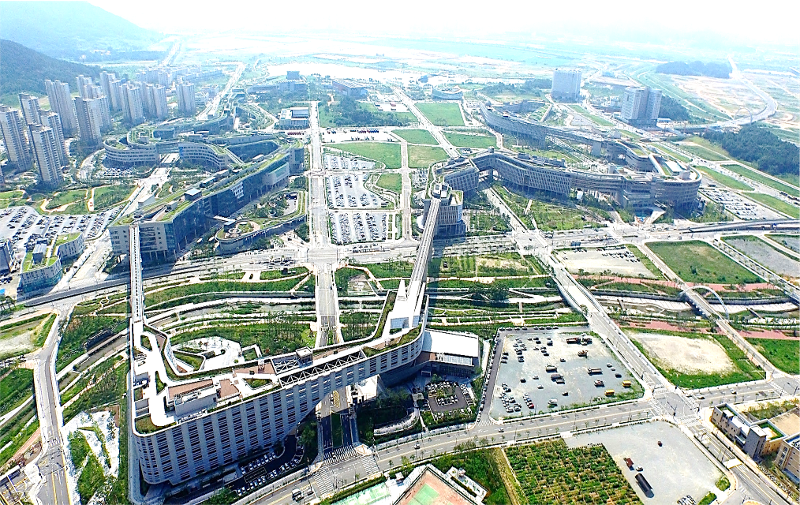
Government Complex-Sejong in Sejong
By Margareth Theresia
Photos = National Agency for Administrative City Construction
The decentralization of administrative functions is part of a national strategy to alleviate overcrowding in the Seoul metropolitan area and promote balanced national development.
Progress has been steady and completion is slated for 2030.
The development of the MAC began with the 2005 enactment of the Special Act on the Construction of the Multifunctional Administrative City, with the relocation of central government agencies and the building of urban infrastructure taking place simultaneously.
Sejong is also steadily growing as a self-sustaining and multifunctional city integrating administration, housing, industry and culture.
Sejong covers 73.01 sq km, about one-eighth the size of Seoul, and is home to about 310,000 residents. The government is speeding up efforts to develop it into a self-sufficient administrative city that can accommodate a population of 500,000 by 2030.
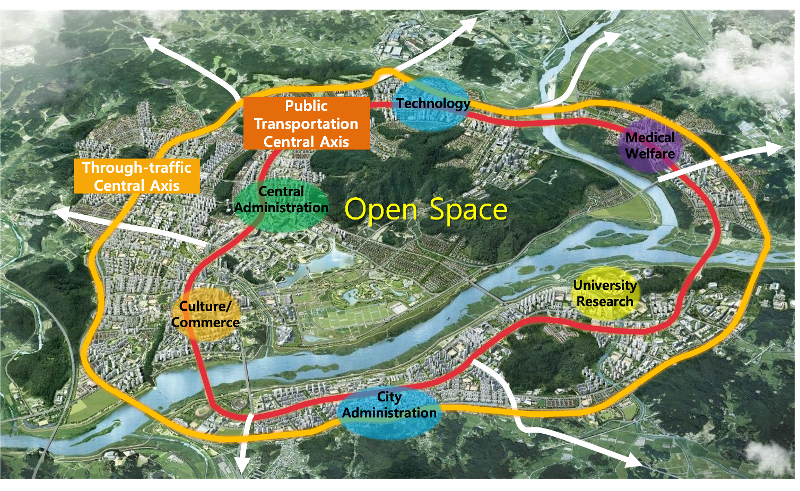
This conceptual plan for Sejong shows the city's six living zones: central administration; local administration; commerce, culture and international exchange; industry, universities and research; medical and welfare; and high-tech knowledge base.
The National Agency for Administrative City Construction (NAACC) defines Sejong as a "model for a future-oriented decentralized city built in the heart of the Republic of Korea."
The innovative urban structure features the world's first ring-shaped urban layout with a large-scale green area at its core. Key functions such as administration, culture, industry and academia are evenly located along the outskirts.
A "double-ring" transportation system that separates inner and outer ring roads efficiently disperses traffic downtown, while 52% of the city's area comprises green spaces to create an eco-friendly urban environment.
Sejong's most notable accomplishment is the relocation and settlement of central government agencies. Since the Office for Government Policy Coordination-Prime Minister's Secretariat was moved to the city in 2012, 44 central government agencies have followed, with some 14,000 civil servants working there.
The city's urban functions are also being expanded. Construction of a new presidential office and a branch building of the National Assembly is part of a mid- to long-term project.
Based on the National Museum Complex, Sejong is expanding its cultural and knowledge infrastructure and evolving into a multifunctional city that goes beyond an administrative hub.
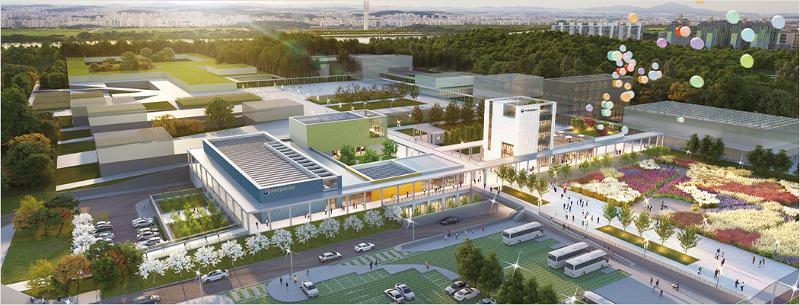
Bird's-eye view of National Museum Complex in Sejong
The Sejong model is also spreading global cooperation. The NAACC has signed memorandums of understanding with Indonesia, Egypt, Mongolia, Tanzania and the Philippines on cooperation in capital relocation and administrative city construction, applying the Korean model of administrative cities overseas.
Since 2019, liaison officers have gone to Indonesia to support the relocation of the new capital and its administration, devise urban planning and build infrastructure. Based on this cooperation, Korean companies are eyeing a role in the building of Indonesia's new capital through the public-private partnership Team Korea Indonesia.
margareth@korea.kr
![[Public admire-stration] ② AI-based disaster response system](/upload/content/image/800fef48140642be8710278532ffb865_20260312082356.jpg)
![[Public admire-stration] ④ Reforestation creates green miracle](/upload/content/image/f0c09b66476e43c7a7f7c3741d1d22cc_20251217162644.jpg)
![[Public admire-stration] ③ AI eases labor shortage at farms](/upload/content/image/a8db1df91e754df3a35cc19b9c82956b_20251212132054.png)
![[Public admire-stration] ① Detecting potential, hidden disasters](/upload/content/image/38ceae8af2704a64b95c13822897ed16_20251210100934.jpg)