- 한국어
- English
- 日本語
- 中文
- العربية
- Español
- Français
- Deutsch
- Pусский
- Tiếng Việt
- Indonesian
Busan in July hosts the 48th session of the UNESCO World Heritage Committee. To mark this occasion, Korea.net introduces six of the country's 12 tentative candidates for World Heritage status.
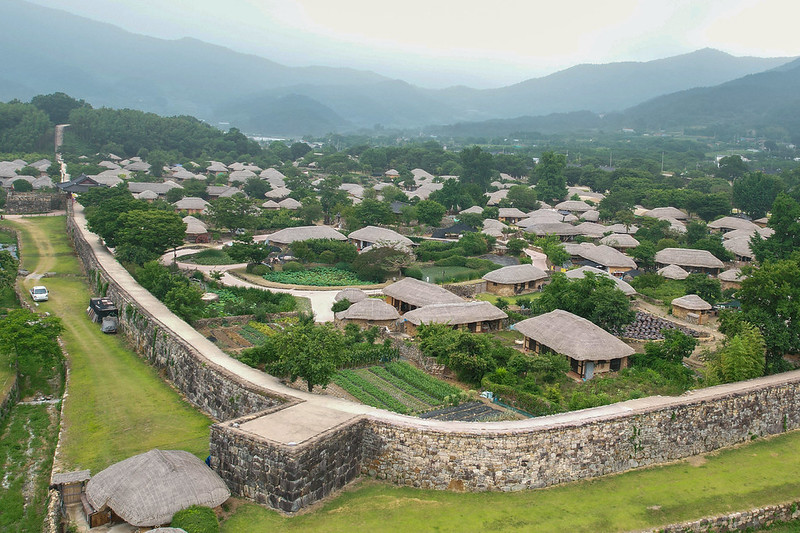
This panoramic view of Naganeupseong Walled Town in Suncheon, Jeollanam-do Province, presents the well-preserved landscape of a Joseon Dynasty town within a stone fortress with a circumference of 1,140 m.
By Lee Jihae
Photos and video = Park Daejin
A place in the low-lying plains of Suncheon, Jeollanam-do Province, is where time seems to have stopped. Naganeupseong Walled Town has preserved the landscape of a village from the Joseon Dynasty (1392-1910) while still housing residents to this day.
Its history dates back to 1397, early in the dynasty's reign, when the Joseon government and people joined forces to build a fortress to defend against rebellions and Japanese invaders.
Eupseong usually refers only to a fortress wall that surrounds the administrative center and residential areas. But Naganeupseong is different as a holistic space covering not just the fortification, but also the town and public offices on its area of 221,000 square m as residents' houses.
The fortification of Naganeupseong initially did not have the majestic appearance that it has now. In its early days, the fortress was made of soil, and was vulnerable to the elements like wind and rain and easy for enemies to penetrate.
That changed after renowned Gen. Im Gyeong-eop in 1626 took over as the magistrate of Nagan-gun County. He strengthened and rebuilt the fortress by replacing the soil with stones.
The fortress today measures 4 m in height, 3-4 m in width and 1,410 m in circumference, a testament to the effective fortification techniques of that era.
The town's tentative listing as UNESCO World Heritage stems not just from being a well-preserved historical site, but also its status as a "living traditional village" where about 200 people in 85 households live to this day. True to its origin as a village focused on agriculture, residents there still work the large fields outside of the walls, preserving their centuries-old legacy.
The town's architecture offers a glimpse at the social conditions of Joseon society. Government buildings like Dongheon, the office of the magistrate where he conducted official business, and a guesthouse for visiting government officials are made of giwa, or traditional roof tiles made of fired clay.
In contrast, the private homes of families who have lived there for generations are thatched-roof cottages, with roofs made of straw or reeds. The differences in architecture are based on social status and function to form a unique harmony within the fortress walls.
The straw or reeds used to thatch the roofs weaken over time due to exposure to wind, rain, sunlight and moisture. Over time, keeping out rainwater gets harder and the roof gradually thins out as insects gnaw at the straw or birds pull it out to build nests.
As a result, the town annually replaces the thatch on the roof with fresh straw.
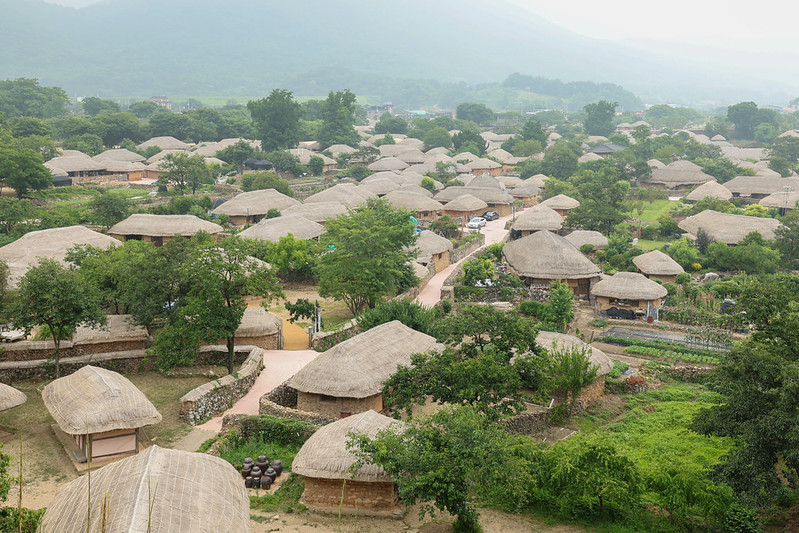
The ridge Bingildeung offers the best panoramic view of Naganeupseong Walled Town.
Going up Bingildeung, the highest ridge section of the fortress wall, offers the reward of the best panoramic view of the thatched-roof village inside the walls. The ridge's name honors Gen. Kim Bingil, who played a major role in the initial construction of the fortress in 1397.
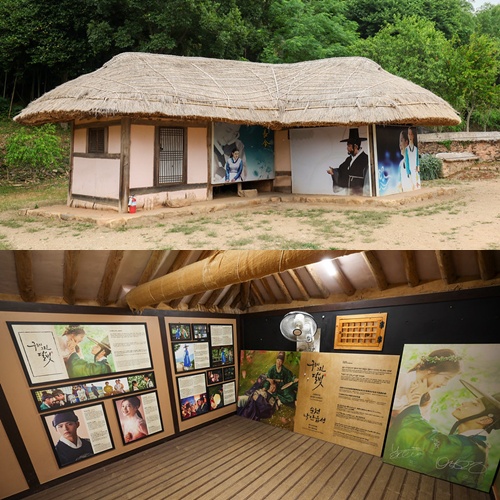
Many historical K-dramas set during the Joseon Dynasty such as the hits "Jewel in the Palace" (2003) and "Love in the Moonlight" (2016) were filmed in Naganeupseong Walled Town of Suncheon, Jeollanam-do Province.
Due to its traditional scenery, Naganeupseong is a popular filming spot for historical K-dramas set during the Joseon era like the hits "Jewel in the Palace" (2003) and "Love in the Moonlight" (2016).
More than just a visually pleasing tourist attraction, Naganeupseong today offers interactive programs highlighting the country's history. Visitors can stay overnight at a thatched-roof house, play traditional games or try traditional dyeing.
jihlee08@korea.kr
![[World Heritage candidates] ④ Upo Wetland: nature sanctuary](/upload/content/image/ee4cf26e9aae411db21fa87b4552ebbe_20260512160028.jpg)
![[World Heritage candidates] ③ Unconventional Unjusa Temple](/upload/content/image/6355fec21ec64a42a5d00e0d8ce36952_20260408092301.jpg)
![[World Heritage candidates] ② Capital Fortifications of Hanyang](/upload/content/image/b4b3560f9a744c8faf89ea5c0c902a1a_20260309082721.jpg)
![[World Heritage candidates] ① Busan: refugee hub of Korean War](/upload/content/image/2013b0a594b344268b6e4bca4795ad63_20260121105424.jpg)