A joint research team from Korea and the U.S. has created live body parts using a 3-D printer.
The team, made up of four Korean scientists and experts from Wake Forest University, announced on Feb. 15 that, “Ear, bone and muscle structures printed using a 3-D printer were successfully implanted into rodents. We noted that the structures had prompted nerve function inside the rats and a blood vessel system had been formed, too.”
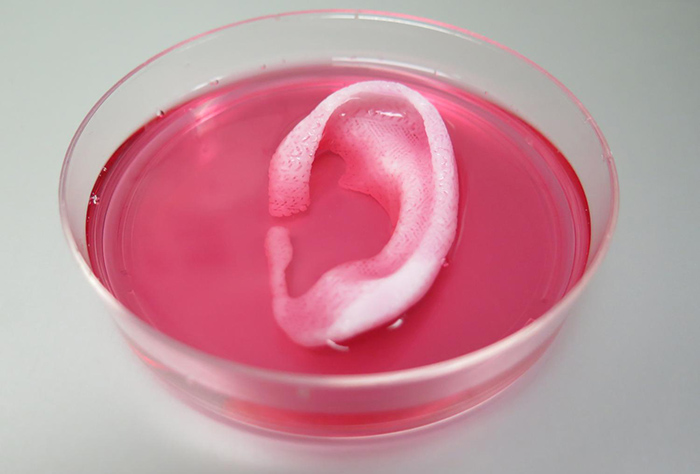
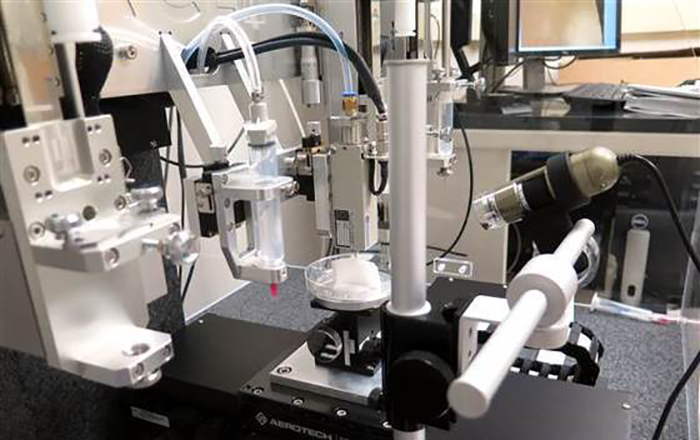
In this experiment, researchers used newly developed 3-D printers, called Integrated Tissue-Organ Printers (ITOP), that spouted water-based hydrogels that contain cartilage cells from a rabbit, along with biodegradable polymers, to make an ear structure. Using only the soft and tender hydrogels would leave any 3-D printed tissues vulnerable to disfiguration. Thanks to biodegradable polymers, however, the structures are more solid, like a real human tissue, the researchers said.
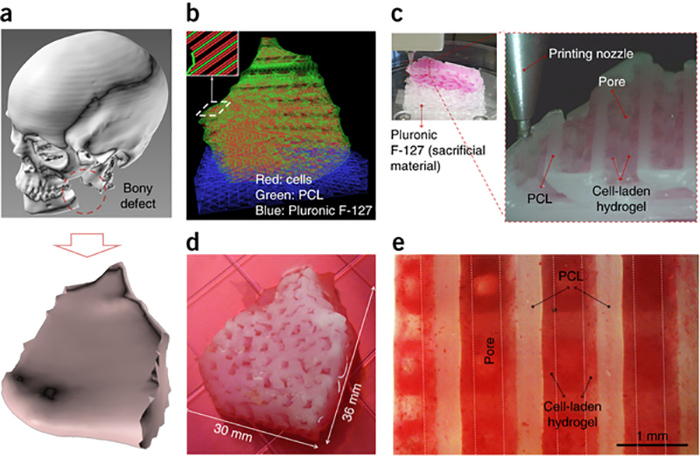
When the printer had to create muscle and bone, the "ink" from its multiple nozzles contained muscle and bone cells. There were fine airways between the tissues through which oxygen and nutrients could pass, as with real biological tissue.
Two months after being implanted into rodents, the ears had kept their shape and cartilage was forming around them. A blood vessel system also formed around the structures. After being implanted, muscles showed normal functions inside the rats' bodies, with nerve tissues staying connected. An implanted jawbone had no signs of malfunction after five months.
Prof. Kang Hyun-wook at the Ulsan National Institute of Science and Technology, one of the four Korean researchers involved with the project, said, “Up until now, this 3-D printing technology has only produced small, soft human tissue. This now is the first time we create relatively large, solid body parts like this. More research should be conducted to find a way to make artificial blood vessels by which nutrients and oxygen could be supplied more efficiently.”
By Sohn JiAe
Korea.net Staff Writer
Photos: Nature Biotechnology
jiae5853@korea.kr
The team, made up of four Korean scientists and experts from Wake Forest University, announced on Feb. 15 that, “Ear, bone and muscle structures printed using a 3-D printer were successfully implanted into rodents. We noted that the structures had prompted nerve function inside the rats and a blood vessel system had been formed, too.”
In this experiment, researchers used newly developed 3-D printers, called Integrated Tissue-Organ Printers (ITOP), that spouted water-based hydrogels that contain cartilage cells from a rabbit, along with biodegradable polymers, to make an ear structure. Using only the soft and tender hydrogels would leave any 3-D printed tissues vulnerable to disfiguration. Thanks to biodegradable polymers, however, the structures are more solid, like a real human tissue, the researchers said.
A Korea-U.S. research team creates a 3-D printed ear structure.
When the printer had to create muscle and bone, the "ink" from its multiple nozzles contained muscle and bone cells. There were fine airways between the tissues through which oxygen and nutrients could pass, as with real biological tissue.
Two months after being implanted into rodents, the ears had kept their shape and cartilage was forming around them. A blood vessel system also formed around the structures. After being implanted, muscles showed normal functions inside the rats' bodies, with nerve tissues staying connected. An implanted jawbone had no signs of malfunction after five months.
Prof. Kang Hyun-wook at the Ulsan National Institute of Science and Technology, one of the four Korean researchers involved with the project, said, “Up until now, this 3-D printing technology has only produced small, soft human tissue. This now is the first time we create relatively large, solid body parts like this. More research should be conducted to find a way to make artificial blood vessels by which nutrients and oxygen could be supplied more efficiently.”
Artificial jawbones can be created with the help of 3-D printing.
A joint research team from Korea and the U.S. uses a newly developed 3-D printer, an Integrated Tissue Organ Printer, to create body tissues.
By Sohn JiAe
Korea.net Staff Writer
Photos: Nature Biotechnology
jiae5853@korea.kr